


Most software companies are built to solve problems for business heads and CXOs. That makes them systems of record, i.e., a single source of truth for one function or a dashboard for the people running it.
Salesforce and HubSpot are the systems of record for customer and sales data, Workday for employee data, and SAP for finance. Automations built in them work within their own departments, like sales emails in Salesforce or payroll in Workday.
Companies’ workflows, however, span across departments. Take, for instance, a new employee joining a large corporation.
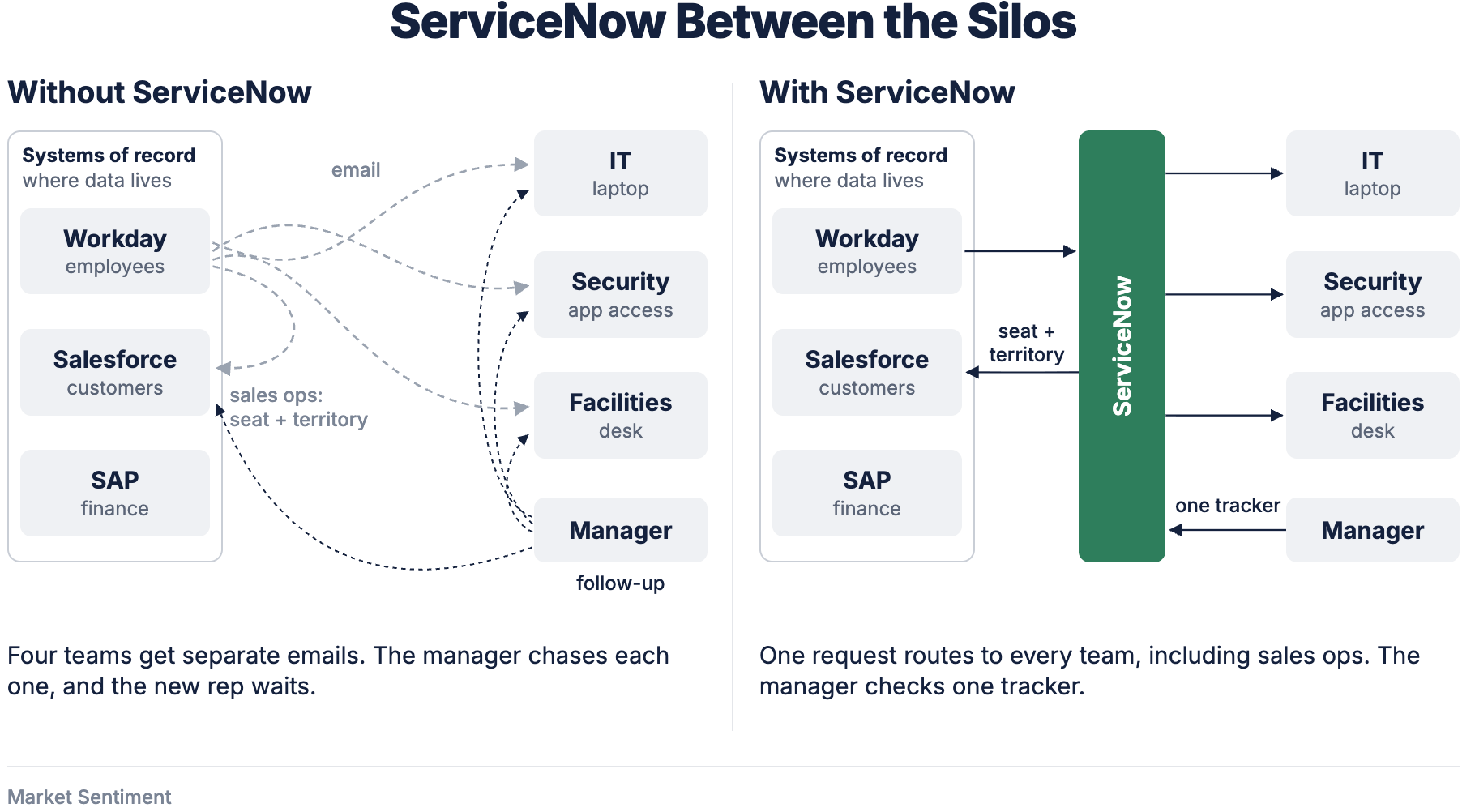
First, HR enters the employee in Workday. Then they raise requests to IT for a laptop, to security for app access, and to facilities for a desk and badge, with her manager chasing all of them.
This is how work gets done in most large companies. Employees bounce across teams, tools, and people, chasing data and permissions to finish a task. Work that moves between these systems has no single owner.
ServiceNow NOW 0.00%↑ was built for these kinds of workflows spanning across teams. Its founder, Fred Luddy, was inspired by the pink and yellow paper slips that carried approval requests from one department to the next through company mailrooms in the 1990s.
Fred Luddy turned that slip system into software. Once an employee files a request, the platform sends it to the right person to approve or act on it and notifies anyone impacted.
Over time, the platform became an important layer that moves work across internal systems run by a company. Hundreds of ready-made connectors can be plugged into ServiceNow to connect Workday, Salesforce, SAP, etc.
With ServiceNow, the new hire’s Workday entry opens every task at once. IT gets a ticket to ship the laptop, Okta creates her logins, and facilities assigns a desk. Her manager tracks it all in one place. While Workday remains the system of record, ServiceNow runs everything needed for onboarding.
Most enterprise tasks touch the IT department one way or another, and that’s where ServiceNow started. IT provisions logins in Okta, secures laptops in Intune, fixes servers flagged by Datadog, etc. NOW tracks all of those apps, laptops, and servers and how they connect.
From IT, ServiceNow expands department by department. When HR or legal needed software for their own workflows, IT recommended the platform it already had, i.e., NOW. Today, HR cases, customer service, and security incidents run on the same system as IT tickets, and that’s how NOW differentiated itself in the SaaS space.
Business Overview:
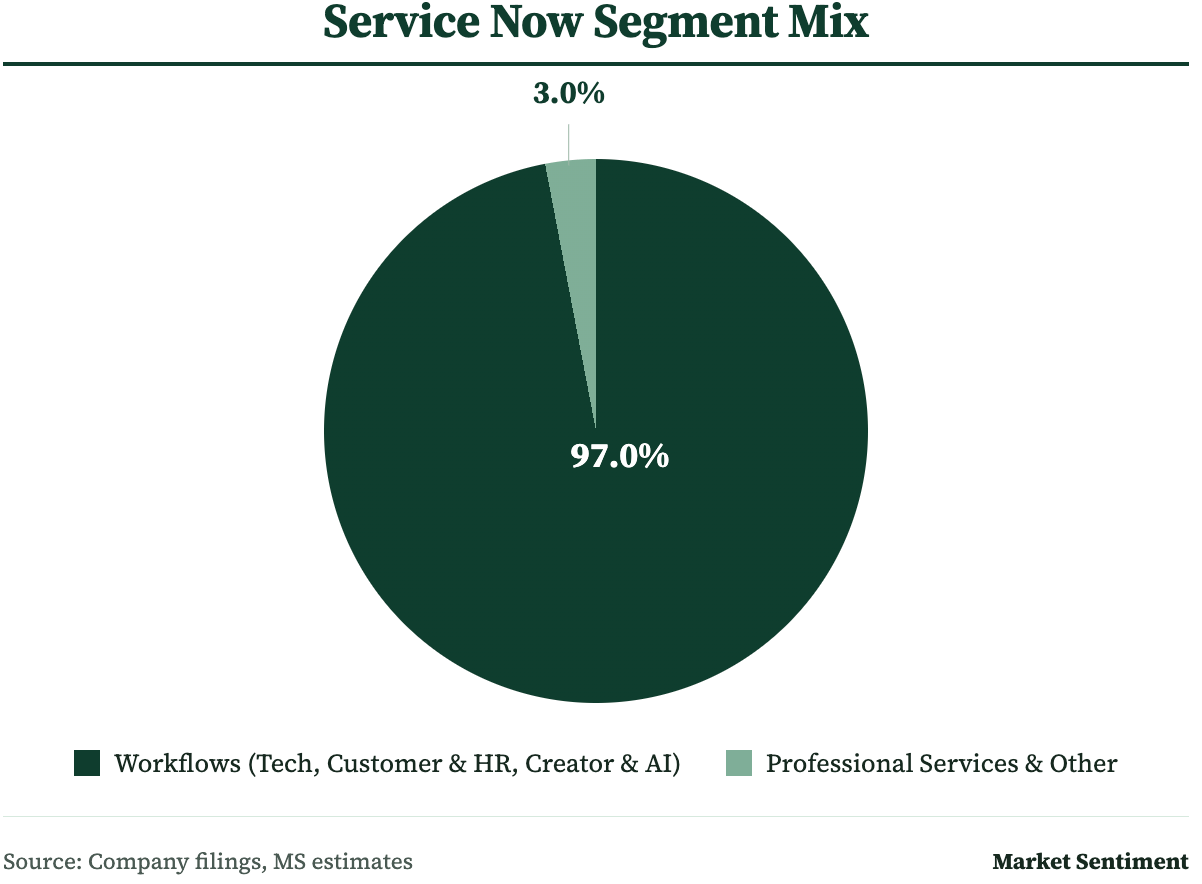
ServiceNow’s primary revenue source is its workflow software subscriptions, which account for ~97% of revenue ($12.9B of $13.3B in FY25). The small remainder is professional services, used mainly to implement its workflow products.
The subscription model gives NOW a business with low cyclicality. It starts each year with largely assured revenue unless a customer exits. Its gross revenue retention rate typically holds at ~98%, reflecting how sticky the workflows are once onboarded.
This stable income also gives it enough bandwidth to reinvest in the business and expand its offerings, improving its chances of sustaining long-term growth.
ServiceNow reinvests in two forms:
S&M: Sales reps continuously engage with customers to understand their workflows and educate them on NOW’s capabilities, acting as a two-way channel between NOW’s product team and its customers. NOW spent 33% of revenue on GAAP S&M in FY25, down from 35% in FY24, and expects it to fall slightly again in FY26 as sales productivity improves.
R&D: This covers product development and maintenance. The platform needs continuous upgrades to support its growing enterprise scale, and AI is driving further product innovation. NOW spent 22% of revenue on GAAP R&D in FY25.
Business Segments:
ServiceNow has expanded its workflows from core IT services into customer service, HR, legal, finance, etc. It categorizes its workflow business into three broad sections: Technology, Customer & Employee, and Creator workflows.
Technology workflows: This is their core IT service desk workflow segment. They have expanded this to include adjacent workflows such as Security Operations and hardware asset management. This business typically accounts for ~50% of their net-new ACV (Annual Contract Value) and remains a major growth driver.
Customer & Employee workflows: This business consists of workflows for sales teams, employee onboarding, legal, etc. Their customer workflows have crossed $2B in ACV, while their employee workflows have crossed $1B in ACV. This business typically accounts for ~30% of new business and goes head-to-head with other major software firms like Salesforce for customer solutions and Workday for HR solutions.
Creator workflows: This is their low-code and no-code software toolkit, including App Engine and Automation Engine, which allows regular, non-technical employees to build custom business applications and automate tasks without needing to write complex code. This accounts for ~20% of their new business.
Growth Strategy:
ServiceNow’s growth has two parts: landing new customers and expanding by selling more to existing ones.
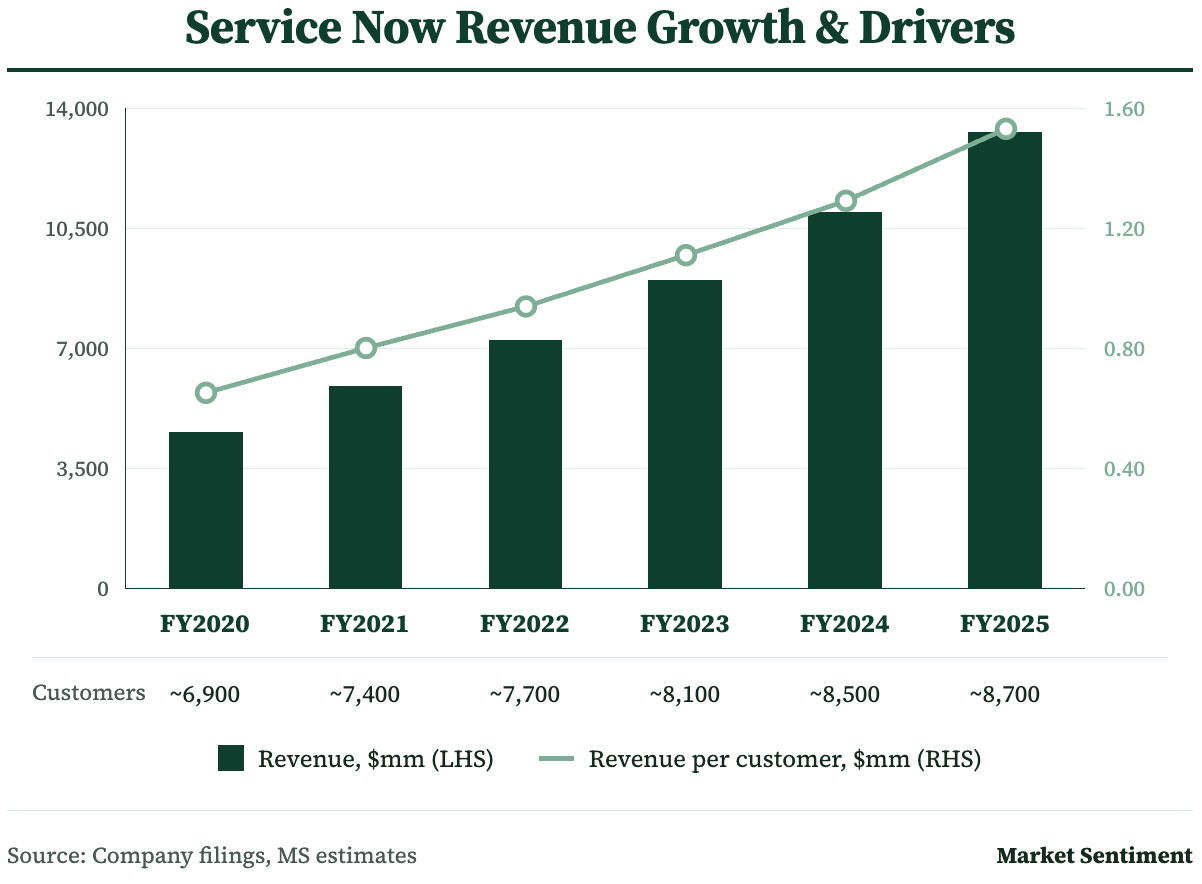
Landing is close to tapped out. It already serves over 85% of the Fortune 500, and its customer base grew only ~5% in 2025, from 8.4k to 8.8k. There aren’t many large enterprises left to sign.
That makes expansion the primary driver of the ~20% revenue growth it is achieving, and the platform is built for sustained expansion across workflows. This is reflected in its revenue per customer almost doubling from ~$700k in 2020 to ~$1.5M in 2025.
It currently has 658 customers paying more than $5M per year, reflecting the scale to which NOW can grow within an enterprise. ServiceNow continues to grow across all its customer cohorts, including $5M+ customers, as it enables AI capabilities and captures more workflows.
Product & Moat:
ServiceNow’s edge is simple. It can run a single piece of work across many different software tools and track it from start to finish. What makes this possible is its Configuration Management Database, or CMDB.
Think of the CMDB as a live map of a company’s technology. Every server, app, laptop, and service is on it. So is every connection between them and the teams responsible for each one.
Here is how CMDB helps: say a bank’s payments app slows down. ServiceNow logs it as an incident. The CMDB immediately shows which server and services enable the payment app and notifies the owner. It also identifies which customer service depends on the payment app and notifies the customer and others impacted. The tickets go straight to every person responsible for the slowdown and impacted by it.
Without that CMDB map, a problem like this means a dozen people on a call trying to work out what broke. With it, the work finds the right people automatically.
In October 2024, ServiceNow added a second layer called workflow data fabric. While CMDB maps a company’s technology, workflow data fabric reaches into its data. It lets ServiceNow read and use information stored in other systems, like a Snowflake or Databricks data warehouse, without copying it over. This covers neat tables of numbers as well as messy data like emails and documents.
Together, the CMDB and Workflow Data Fabric give ServiceNow’s AI agents what most AI tools lack: context.
Let’s go back to the payments app. The CMDB tells the agent which server failed and who owns it. Workflow Data Fabric lets it pull the failed transactions from the bank’s data warehouse to see how many customers were affected and can notify them as the service comes back online. One tells the agent how things connect. The other gives it the data to act on.
AI agents are only as useful as what they can see, and every new workflow a customer builds on ServiceNow adds to the picture of how enterprise workflows flow. This is a big reason NOW’s AI products crossed $1B in annual contract value (what customers are signed up to pay each year) in under 3 years. Most AI startups would envy that.
None of this works out of the box. The CMDB and workflow data fabric only become valuable once they are wired into the hundreds of apps and data sources a company already uses. That takes time. NOW’s 10-K says each rollout depends on the customer’s integration, data migration, compliance, and security needs. This can take several months to quarters.
That effort is what makes NOW hard to leave. Switching means rebuilding every one of those connections in a new product. And because NOW’s workflows run across departments like IT, HR, and customer service, a company cannot move one at a time to another product without breaking the links between them.
The numbers back this up: NOW’s renewal rate has been 98% of contract value for years.
Over time, NOW stops being just another tool and becomes the place where work gets done. This goes well beyond corporations. Nearly all US states use the platform. The City of Raleigh, North Carolina, used NOW’s AI agents to cut its IT help desk costs by 66% (Q2 FY26). If I’m a CIO, I’m not ripping that out to save a bit on licensing.
ServiceNow AI Control Tower:
Earlier, we saw how CMDB and Workflow Data Fabric keep NOW at the center of enterprise AI agent adoption. Its pole position in enterprise workflows makes it a natural place to run those agents, and it has extended this capability into a new product called AI Control Tower (launched in May 2025).
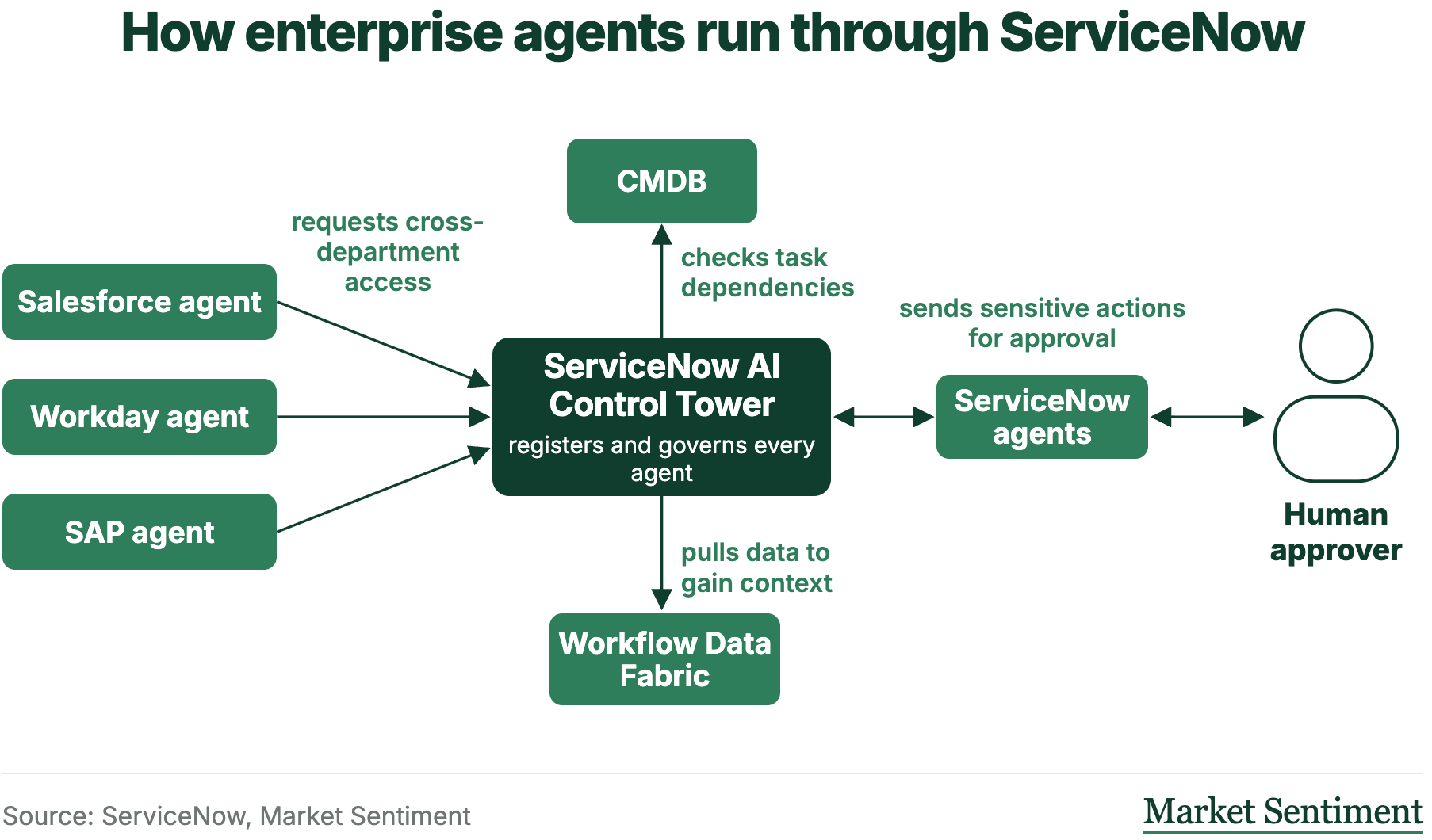
AI Control Tower is a command center for every AI agent and workflow in an enterprise, whether it’s built on ServiceNow or elsewhere. It discovers them and applies standard policies, ensures compliance, and measures what each one delivers.
This is CMDB adjacency, just like a CMDB registers servers/apps and their dependencies. AI Control Tower registers agents, what they can access, and who owns them. Because NOW already holds the map of the workflows these agents need to act on in CMDB, it can identify when agents sidetrack.
With AI Control Tower, NOW positions itself above the AI vendors, entrenching itself as an enterprise AI platform rather than being absorbed by one.
AI impact on NOW’s Business & Pricing:
NOW has traditionally priced its product on a per-seat basis, licensed by fulfiller, i.e., employees who work on the platform auto-remediating tickets and building workflows. Some products, like IT asset management, are priced by devices managed, connectors, data transferred, etc.
AI makes their seats more productive, so fewer of them clear the same work. Street is concerned about the impact of seat compression on NOW’s revenue and their ability to mark up pricing for any loss of seats. The company now trades at $137, ~40% below its last year high.
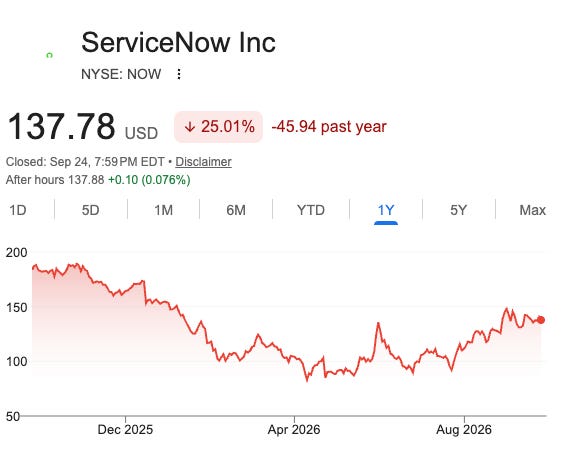
So it all comes down to whether AI will be a headwind or a tailwind for the company. To find out, let’s dig into:
How ServiceNow is pricing its AI products
Which companies can realistically challenge them
Current profitability and stock-based compensation concerns
NOW DCF Model and Market Sentiment rating