


A Stranger Things hoodie from Netflix. A Barbie or a Hot Wheels set from Mattel. A box-logo tee from Supreme. A bodysuit from SKIMS. Every one of these stores runs on Shopify.
None of these brands lacks the resources to build its own. Supreme ran a custom-built site for years before moving to Shopify in 2023. And they are far from alone. Millions of merchants in 175+ countries now use Shopify, reaching roughly 900M shoppers.
It started as a side project. In 2004, Tobi Lütke wanted to sell snowboards online under his own brand. He tried Yahoo! Stores, Miva, and osCommerce, but none were good enough. So he built his own storefront. Soon, other merchants wanted one too.
Shopify was built for merchants who don’t want to be just another product among Amazon’s 600M+ SKUs, but want to give consumers a better shopping and brand experience with their own digital storefront. When Shopify started, Amazon was already at a scale of ~$6.9B in sales, selling everything from books to electronics, but that didn’t stop Shopify from becoming one of the fastest-growing e-commerce companies today.
As Shopify scaled, it stuck to the same problem, helping people build their own brands, and expanded from a simple digital storefront to global payments integration, checkout optimization, working-capital credit, tax calculation, inventory management, advertising strategies, and more.
As AI progresses to reshape retail shopping, Shopify is already positioning itself as the leading enabler of independent online retailers. AI-driven traffic to Shopify stores and orders from AI-powered searches grew nearly 3x YoY in 2Q 2026.
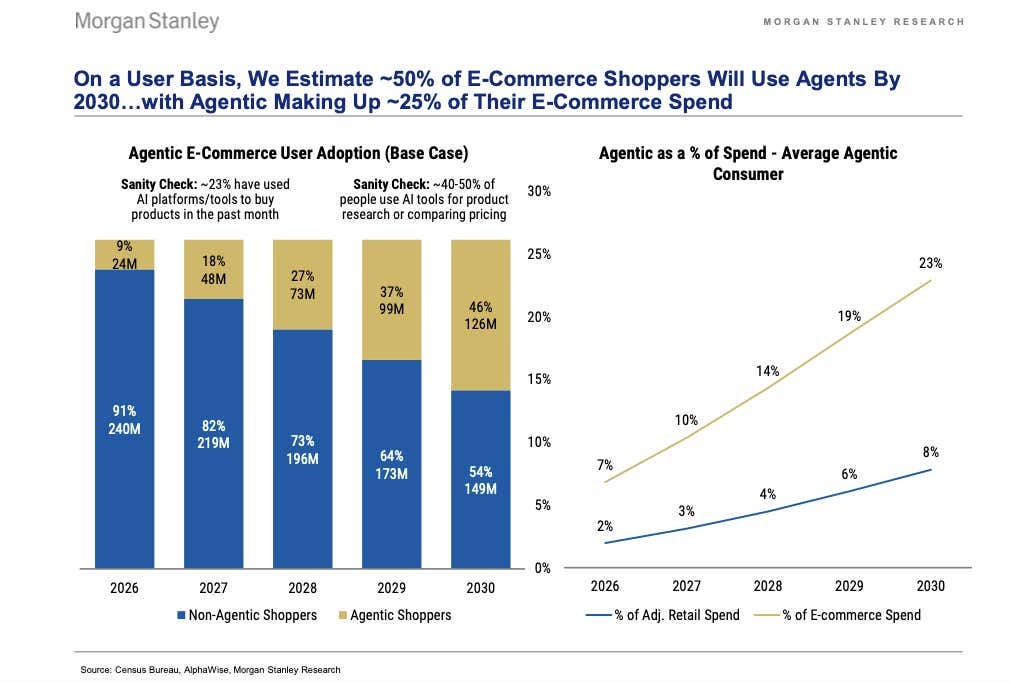
The question is whether AI agents make Shopify more essential or easier to replace. Agents don't care about storefront design. They need a catalog they can query, a checkout they can call, and a payment they can settle. Shopify is building all three, and it switched on every eligible US merchant by default 6 months ago.
But at ~110x earnings, the stock already prices in 30%+ GMV growth and margins of 20%+. Below, we break down how Shopify makes money, why agentic commerce could widen its lead, how durable its moats are, and what we think the stock is actually worth.
Business Model:
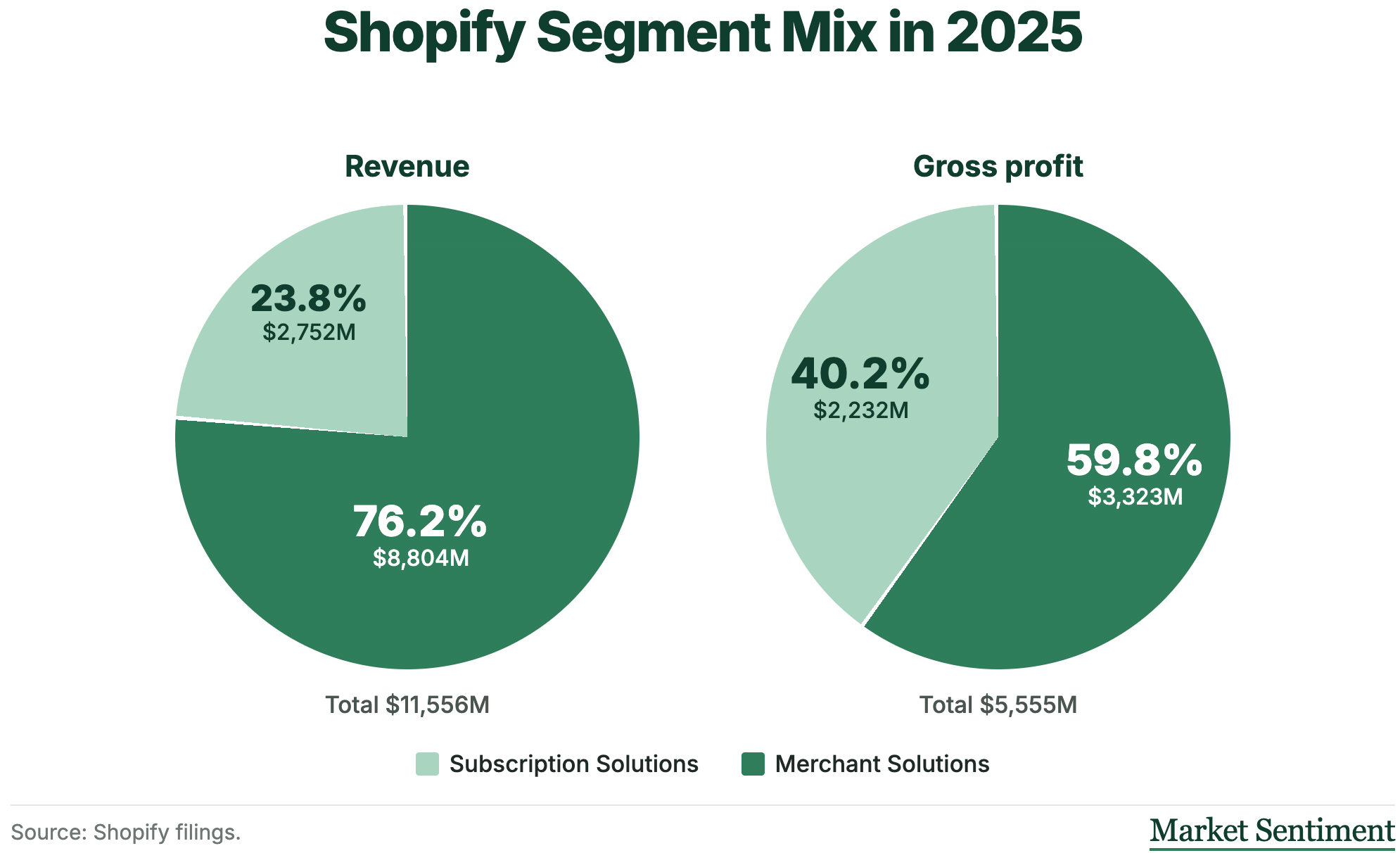
Shopify has 2 major revenue streams: subscription solutions and merchant solutions.
Subscription solutions: They first onboard a retail merchant by giving them a basic digital storefront, which includes a website, checkout, and inventory management. They charge a largely fixed subscription fee for managing these services. Their subscription prices have four main tiers, with Basic priced at $29/mo (billed annually), Grow at $79, Advanced at $299, and Plus for large firms from $2,300. This is a high-margin business with ~80% GM.
Merchant solutions: Once a merchant purchases a subscription, Shopify sells additional services like payment processing, shipping, advertising solutions, etc. Shopify makes money in this stream only if merchants make money. They take a simple cut of merchant sales for most of their products here. The gross margin of this business is ~40%.
Payments is their largest contributor to merchant solutions. Shopify processed ~$248B of payments in FY25, or ~66% of total GMV, up from 45% in 2020. This segment has a significant runway, as they launch in new geographies like India and LatAm ex-Mexico, where Shopify Payments isn’t available today. In mature markets like North America, close to 90% of merchants already use Shopify Payments.
Their other services in merchant solutions are still smaller / in early stages:
Shopify Capital: ~$2.2B loan book, with ~$1.6B deployed in Q2’26 alone.
Shop Pay Installments: BNPL product, GMV grew by 53% YoY in Q2’26.
Shopify ads (Shop Campaigns): Merchants running live campaigns tripled YoY in Q1’26, and for some small merchants it drives up to a quarter of GMV.
POS hardware: GMV grew 32% YoY in Q2’26.
Agentic Commerce & Shopify’s Role:
Consumer AI is graduating from simple chat inference to complex task handling. Meta’s Muse launch has accelerated this process, with Muse being downloaded 5 million times within 22 days vs. the ChatGPT app’s 5 million in 56 days.
Consumers, on average, take ~26 days from their first search on platforms like Amazon to decide on and purchase a product. Consumers have to compare multiple product features, along with prices and payment offers, before deciding on the final purchase.
AI agents excel at exactly these kinds of comparative tasks. But, as with all AI applications, clean data with better context will improve the efficiency and accuracy of these systems.
Traditional digital shopping infrastructure is built around websites optimized for human clicks and eyeballs to improve conversions. This is not the most efficient infrastructure on which AI agentic commerce can run.
Agentic Infrastructure:
An agent can browse a store the way a person does, but it’s slow and brittle. It has to read pages built for humans, and a layout change or bot check can break the purchase. Agents work best when each step of the purchase is a machine call. Search becomes a catalog it can query. Checkout becomes an API, where the merchant still prices tax and shipping. A stored card becomes a payment token capped to one purchase and amount. A saved password becomes account access granted by permission.
For agents to transact with millions of shops, everyone in the stack — the consumer’s agent and the retailer’s systems — needs to speak the same machine language. Two open standards have been built to solve this: OpenAI and Stripe’s Agentic Commerce Protocol (ACP, September 2025) and Google’s Universal Commerce Protocol (UCP, January 2026), co-developed with Shopify.
Both protocols cover the same journey: discover product, build cart, check out, and track order. ChatGPT uses ACP mainly to ingest merchant catalogs, and final payment occurs at the merchant’s checkout. Google uses UCP to close the full loop, as it integrates with agentic payment solutions such as Google Pay and the Agent Payments Protocol (AP2).
Every eligible U.S. Shopify merchant was switched on by default on March 24, 2026, with out-of-the-box access to ChatGPT, Copilot, AI Mode, and Gemini, and zero integration work. A non-Shopify merchant has to set this up through its own platform or build its own AI-readable catalog, or risk losing the demand coming from these agents.
Google, OpenAI, and now Meta are building the surfaces where the asking happens. Shopify is building the catalog, the cart, and the settlement underneath, with Shopify Catalog feeding ChatGPT and Shopify checkout embedded in Copilot.
Agentic Commerce Value Unlock:
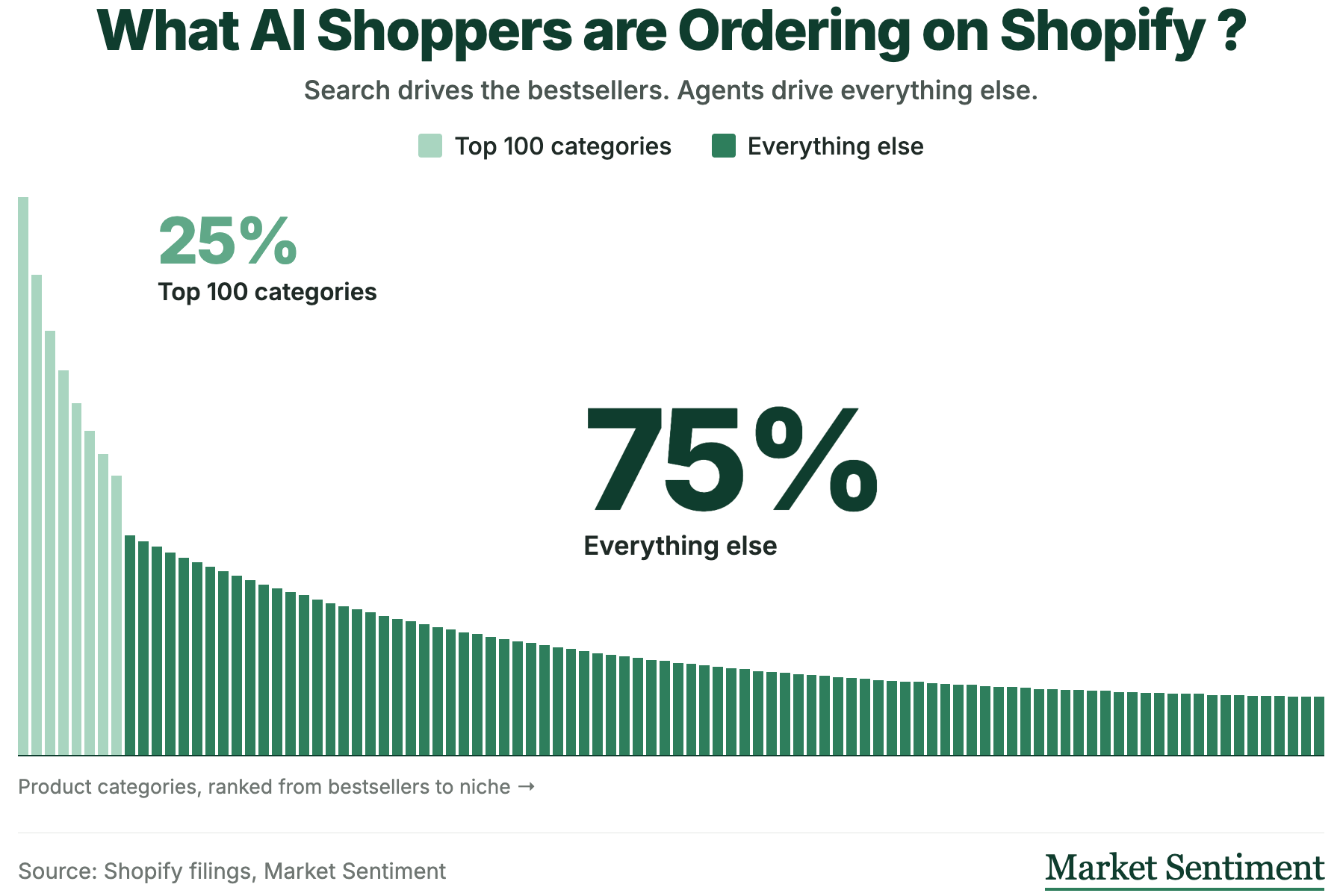
Historically, search has favored bestsellers and products with high ad spend. Agents can parse detailed queries against product attributes, so a niche product that better fits the brief can win in the agentic commerce world.
In 2025, 71% of AI-attributed orders on Shopify came from outside its top 100 categories (long-tail orders), compared with about 55% of sales overall. The long-tail share of AI-attributed orders increased to 75% in 2Q26, reflecting a clear benefit for niche products and categories.
Amazon typically charges sellers a 15% referral fee, and many also spend on Amazon ads to stay visible. Niche products will find it difficult to pay such costs at low volumes. Selling direct gives brands more room to offer better value, while agents can find these products more easily than shoppers searching the web.
The AI catalog itself is just another subscription feature for Shopify. The bigger opportunity comes from any additional GMV that agents send to long-tail merchants, from which Shopify makes money through payments, credit, etc.
Business Moats
Shopify’s moats come from its improving product scale, higher switching costs and lower customer acquisition costs: