


Hi there, this one’s a bit different from our usual reports.
We have been thinking long and hard about how the economy and markets are shaping up. With AI, every industry is being pushed to its limit, and decades of investment are being made every few weeks. The current geopolitical situation is just adding fuel to the fire.
We believe there is significant alpha at these bottlenecks — to capture this, Market Sentiment is transforming into a full investment platform. (more on this later).
While everyone is aware of the increasing capital allocation by companies to AI infrastructure, almost everyone misses the true scale at which we are doing this. Here are some numbers to put things in perspective (all figures adjusted for inflation):
Every month, we are spending more on AI infrastructure than the total cost of the Manhattan Project.
Every quarter, we now allocate more to AI than the entire 14-year Apollo program.
Just last year, we spent more than what it took to build our entire Interstate highway system over three decades.
While no one can be certain whether AI has the potential to generate returns on this scale of investment, the massive amount of capital being pumped in is pushing companies, industries, and technology to their limit.
The problem we have noticed here is that most media outlets just attribute AI to the Magnificent-7 stocks and do the bare minimum due diligence on other companies. The “research” is so bad that, just a few years ago, the BBC News called ASML "a relatively obscure Dutch company."
We believe the real impact (and alpha) lies with the second- and third-order companies and industries. A $100B deal now barely moves the needle for Nvidia, but even a $1B deal for a supplier to Nvidia will double its stock price overnight.
We have been watching this play out over and over again in the past year.
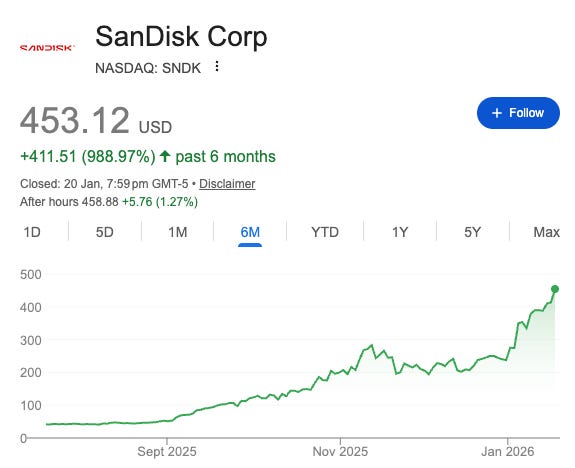
If you’ve ever saved an AI-generated image, you’ve likely noticed the massive footprint: A simple Gemini-generated image can easily reach 10 MB, nearly ten times the size of a standard screenshot. Now imagine how much storage a Gen AI video would take. We are watching an entirely new market for memory chips being created, and unsurprisingly, storage company stocks are going parabolic!
You must have noticed your electricity bill creeping up lately. It’s because data centers already consume 5% of total US electricity demand, and that demand is rapidly rising. Energy remains a bottleneck, with hyperscalers scrambling to lock in long-term energy deals to power their data centers. We have already covered in depth 2 months ago with our energy portfolio, which is now outperforming the index!
The massive scale of investments is pushing the boundaries of what’s possible — we have already hit the limit on how fast data can be transmitted through traditional Copper cables, and companies are rushing to develop better technologies to overcome this Copper Wall. The portfolio we put together last month now has now 4.3% return compared to -2.8% for QQQ.


This is just scratching the surface. There are dozens of other industries and companies at the limit due to this massive capital inflow and demand. Here are a few more that are on our watchlist:
Advanced Packaging
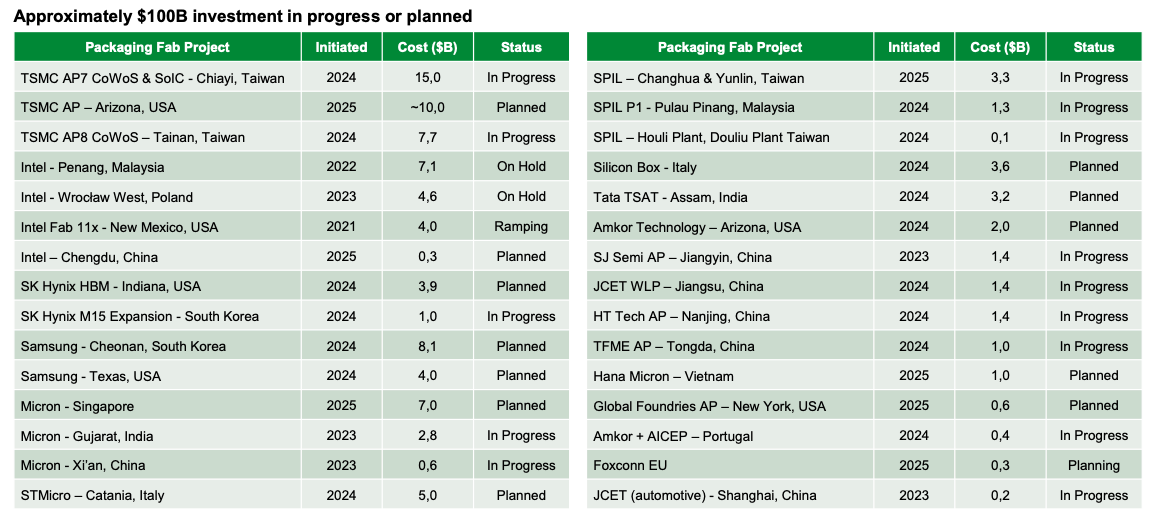
The need for an exponential increase in computational performance for AI means that we have already reached the limits of Moore’s law of adding more transistors to a single chip. The proposed solution is to go beyond single-chip packaging by integrating multiple dies, memory, and functions into a single system using advanced packaging. The demand for a solution is so strong that more than $100B in capital has been allocated to advanced packaging alone.
Copper & Other Commodities
The data center boom (Copper is required everywhere as the primary conductor) and supply disruptions at major mines in Chile, Peru, and Indonesia have driven Copper prices up by ~40% over the last year. Lithium has also doubled in price in the last year.
The U.S. Grid
The U.S. Department of Energy had highlighted the shortcomings of the current grid a year before ChatGPT was released. Most of the transmission lines currently in use were laid in the 20th century and were never designed to carry so much load. With the U.S. home to 45% of the world’s data centers and modular nuclear reactors at least half a decade away, the U.S. grid will need massive improvements to sustain the current pace of progress.
As anyone who has worked in a manufacturing plant will agree, bottlenecks get all the attention and capital. It’s natural, since that’s the section holding up the entire plant. We have been watching this play out over and over again in the past year. The alpha is in the bottlenecks, not the hype.
Starting today, we are no longer researching these trends but will build portfolios and invest in these bottlenecks.
Just as with Rebound Capital, we like putting money where our mouth is. So if we are recommending any industries or companies, we will back our recommendations with real capital and share regular portfolio updates with you.
Nothing changes for you if you are an existing paid subscriber to Market Sentiment. While the research required to find these bottlenecks is intensive (as you probably can tell from our Energy and Copper Wall Reports), you can enjoy these reports and deep dives at the same price.
For everyone else, we will increase our pricing from $247/year to $497/year 24 hours after this report goes live — So, this is your last chance to upgrade the subscription at the current price :)
p.s. — If you are an existing paid subscriber and not enthusiastic about this new direction, we understand and are happy to give you a pro-rated refund. Just reply to this email :)
Very interesting. I need deep into it. Thanks
This resonates. Bottlenecks are where reality leaks into markets. They’re unglamorous, capital-hungry, and hard to narrative-surf, which is precisely why they misprice for so long.
What I appreciate most here is the commitment to embodied conviction—research that graduates into balance sheets. Alpha tends to show up where capital is patient enough to wait for throughput, not headlines.
Curious to see how you think about timing risk in these choke points—when relief comes suddenly rather than gradually, the unwind can be just as violent as the buildup.