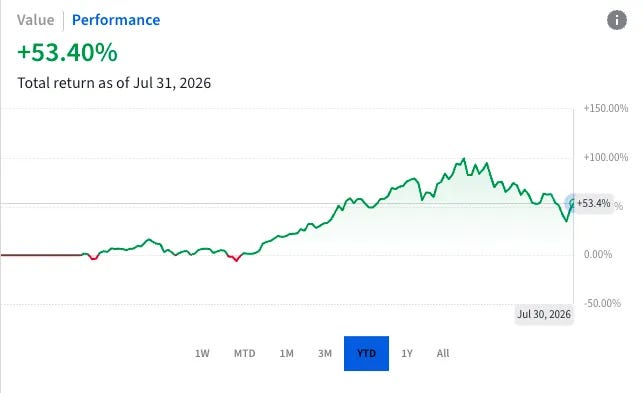
First things first.
Judging by DMs we received last week, a lot of you are running portfolios wildly outside your risk tolerance. While we cannot recommend custom portfolio strategies, a simple trick I have learned over more than half a decade is to build a sleep-well portfolio.
The setup is simple: your portfolio should be structured in a way that you can sleep through the market open without missing a beat. Most of us are not fund managers, and there is no good reason to check your portfolio every hour (and it's detrimental to your happiness irrespective of how the portfolio performs). If you are all-in, or worse, 4x levered like Leopold on names that have gone up 2-5x in the last year, you are asking for trouble. Having a reasonable exposure will also help you think rationally, which is exactly what we were doing a few days back (with the thesis playing out literally the next day).
With that, let’s get into the big developments over the past month, how our portfolio performed, and how we are positioning over the next few months.
Overall, it was quite a bad month for AI bulls with the SOXX semiconductor ETF down 21% and memory names taking a beating (DRAM was down ~30% last month).
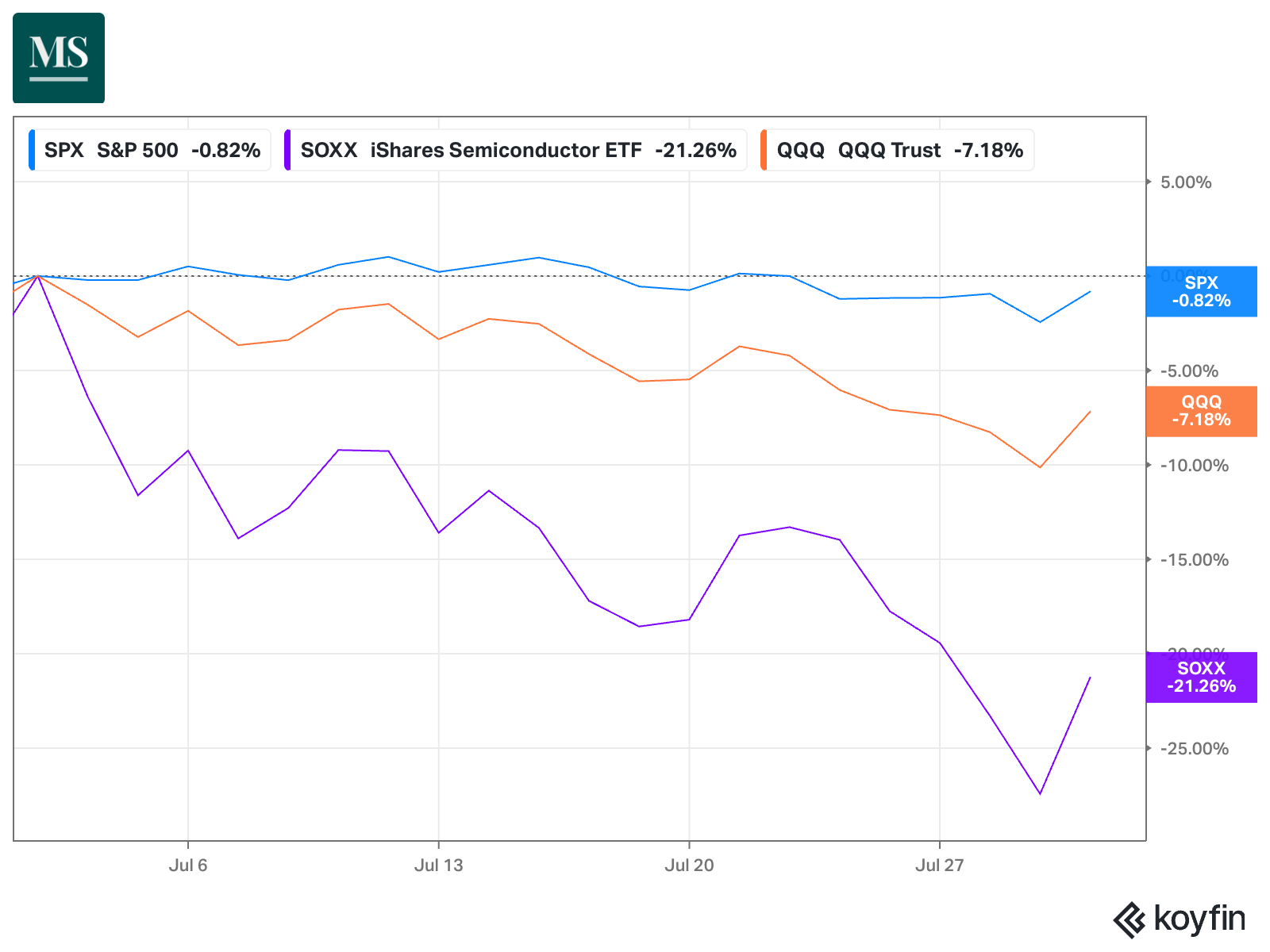
We see this correction as unwinding of leverage and portfolio concentration that’s been building in semis. Korea’s leveraged ETFs had ~$10B AuM at the beginning of 2026. By June it ballooned to ~$50B with SK Hynix-linked leveraged products alone at ~$23 billion.
On July 16, South Korea’s Financial Services Commission announced stricter regulatory rules for single-stock leveraged ETFs, raising the minimum margin requirement from 10 million Korean Won to 30 million Korean Won and limiting purchases to a maximum of 20 shares per person per transaction.
During the stock price decline phase, the mandatory end-of-day rebalancing mechanism of leveraged ETFs triggered programmatic automatic selling, instantly creating a sharp selloff. That day, SK Hynix fell another 11%, Samsung slumped over 8%, and the wave of panic quickly swept through Europe and the US. Leopold’s $45 billion AI fund blowing up last week added fuel to the fire.
While the correction can be largely attributed to normal market volatility amplified by leverage, there were quite a few material events:
The launch of Kimi K3
Moonshot released Kimi K3 on July 16, the largest open-source model with 2.8 trillion parameters. AI capability benchmarks have placed it on par with OpenAI 5.5 and Opus 4.8.
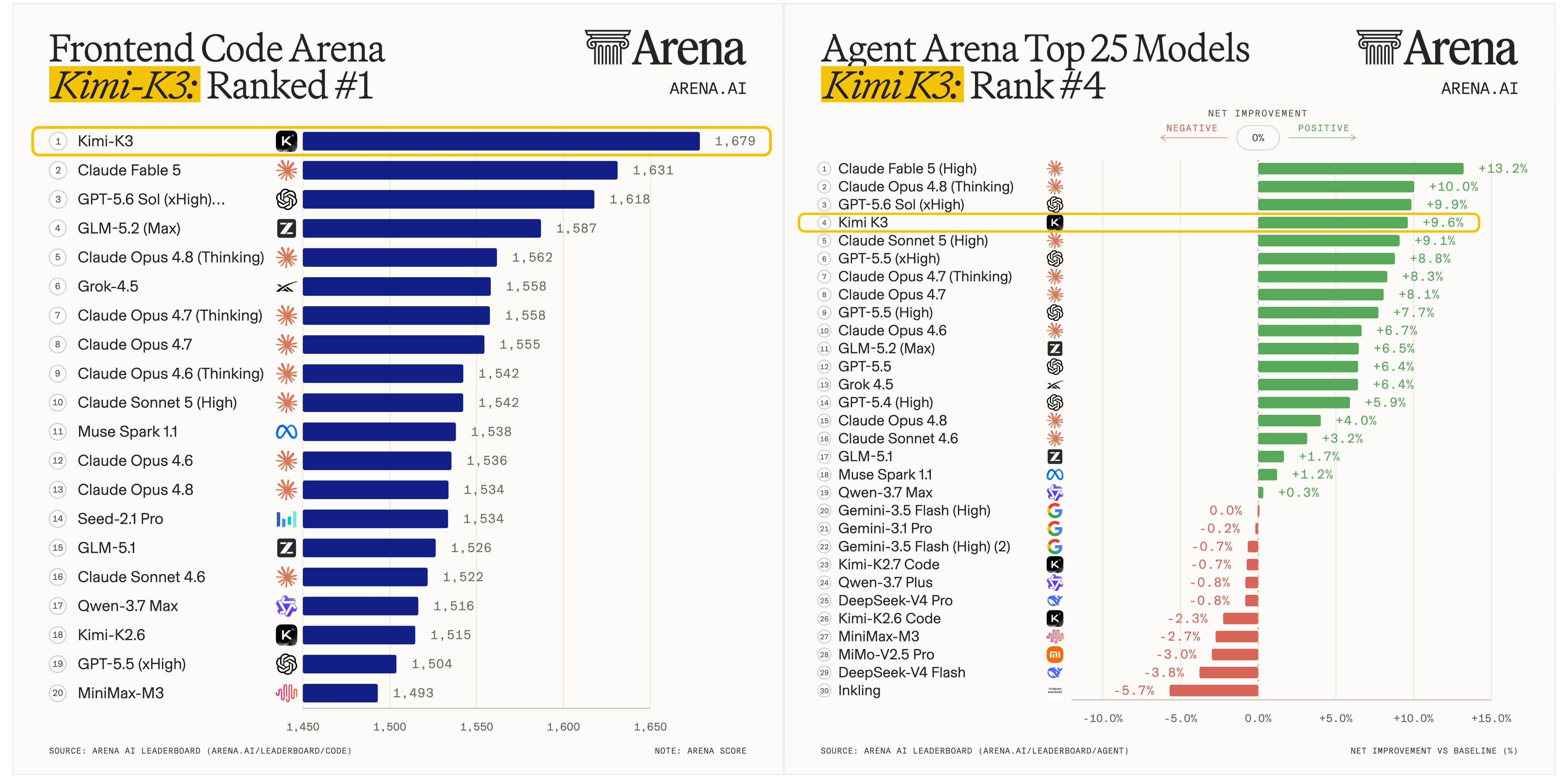
Kimi follows a dozen open-source, low-cost models China has released since DeepSeek R1. In our view, AI adoption gains far outweigh open-source AI efficiency gains, as reflected in Nvidia’s sharp rebound post the first DeepSeek event.
But companies are currently in the token-maxxing era. Every employee, whether they need it or not, has access to frontier models with a nearly unlimited AI budget. There will come a time when companies see the AI bill and ask if it’s really providing the ROI. This does not mean they will stop using AI. They will just optimize it better.
There’s no need to use Claude Fable 5 to rewrite your email or update your deck for the 20th time. Open source models can do the same at 1/100th of the cost. Serving intelligence becomes a race to the lowest cost per token, the same way Japanese carmakers won the US market by delivering most of the performance at a much lower price.
CXMT had a monster IPO
CXMT is a Chinese memory company holding 8% of global DRAM capacity. CXMT listed on Shanghai on July 27, raising $8.6B in Asia’s biggest IPO this year. It popped 466% on debut, valuing it at ~$500B+ as one of the most valuable China-listed companies.
China’s semiconductor capability buildout is well known; however, it lags the leading edge by a few nodes, and CXMT itself doesn’t have HBM capability.
New memory capacity by Korean players
Samsung and SK announced investment of ₩800T (~$516B) in four new fabs to double memory capacity within five years. This is the most significant news for memory names with questions on disciplined supply. However, new capacity comes online only in 2H27–28, keeping memory in tight supply for the next 4Qs.
These plants are backed by major contracts for Korean memory names. SK has long-term contracts of ~$700B ($500B with Nvidia, Microsoft, Anthropic) while Samsung has ~$200B (Broadcom MOU).
While the Capex addition is real, the quantum of Capex should be taken with a pinch of salt, as these announcements were made as part of a South Korean government super-industrial plan and not a corporate strategy event. Historical precedent shows that memory companies will delay Capex if they don’t see supportive pricing (2022-23 delayed wafer starts). Thus, we see this capacity addition plan having no impact for the next 1-2 years, and the supply-demand dynamic at that point will be tested based on AI adoption.
MS Portfolio Update