


No paywall on this one. Share with a friend :)
Markets have sold off twice on the same story. Both times, the trigger was a low-cost open-source model matching frontier models on benchmarks.
The first was DeepSeek R1 in January 2025. NVIDIA fell roughly 17% in a single day. The second was Kimi K3 in July. The SOX index dropped about 2% on the news, then slid 10% over the week as leverage and profit-taking compounded the move.
The reasoning behind both selloffs was the same. Cheaper open-source models mean AI labs can’t earn enough to cover compute costs.
We think that reasoning is too simple. The real impact of open source runs through a set of harder questions.
Why are open-weight APIs so cheap?
How are open-model companies staying alive?
What does this mean for the AI labs?
And how did open source play out the last time it reshaped an industry?
Open model pricing is a distribution, not a number.
Open model weights are public, and anyone can download them, but running them still means managing large GPU clusters and the software stack. The software stack creates differences between multiple providers serving the same open weights. Inference providers can optimize their software to prioritize price, latency, or accuracy while serving the open weights. Depending on how they optimize, each inference API will be positioned at a particular price-to-spec market.
DeepSeek’s first-party API provides DeepSeek V4 Pro at a blended cost of $0.20 per 1M tokens, while the same model weights are sold at $1.90 by Azure, a ~10x price differential across hosts serving identical model weights. Azure's pricing premium is justified by lower latency and higher accuracy.
On the other hand, Claude Opus-5 costs $3.90 per 1M tokens on every cloud (Azure, AWS, and GCP), even if performance varies slightly, because a single model owner sets the price.
Headline “open is 10x cheaper” comparisons often quote a cheaper version (DeepSeek Cloud) with degraded performance, exaggerating the cost benefits of open weights. For instance, Opus 5 can look ~20x more expensive than DeepSeek, but on the same Azure platform it is only ~2x more expensive.
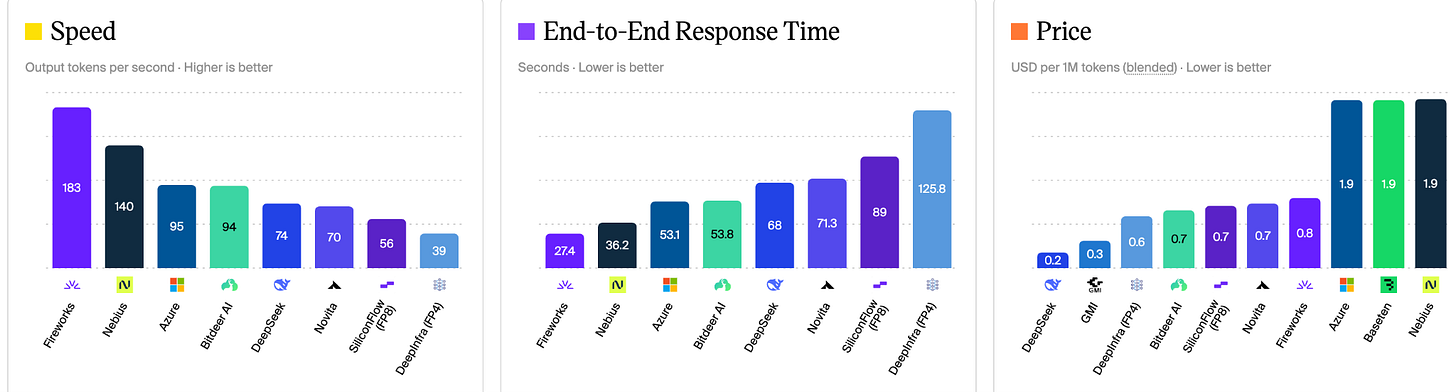
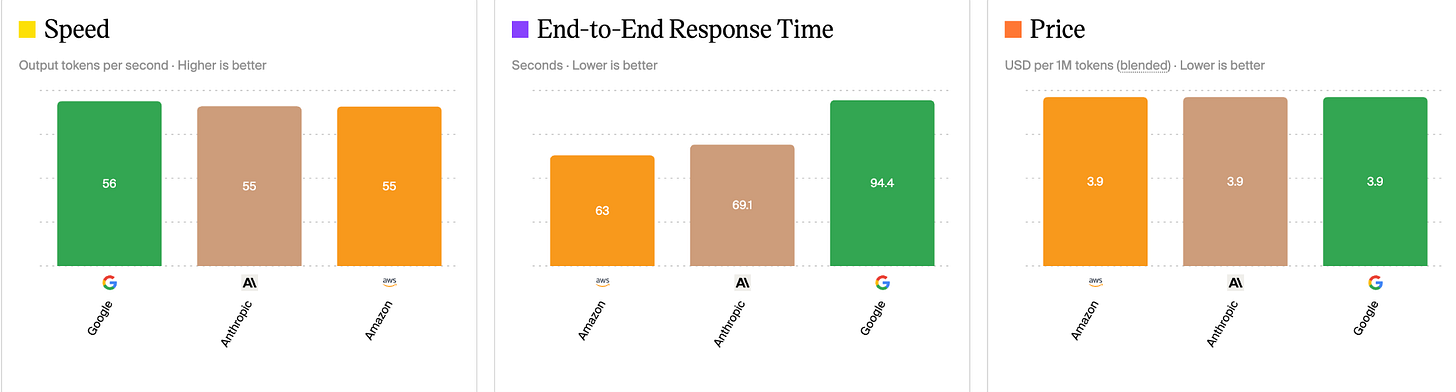
Token price is determined by GPU-hour cost and how many tokens you can squeeze per GPU-hour. GPU costs are similar across firms; they differ in how many tokens they extract from each GPU-hour.
Precision: Model weights are simply a set of numbers in matrices. Every number is stored using a fixed count of binary digits. Fewer binary digits mean less accuracy when storing a number, which can reduce inference accuracy while saving compute.
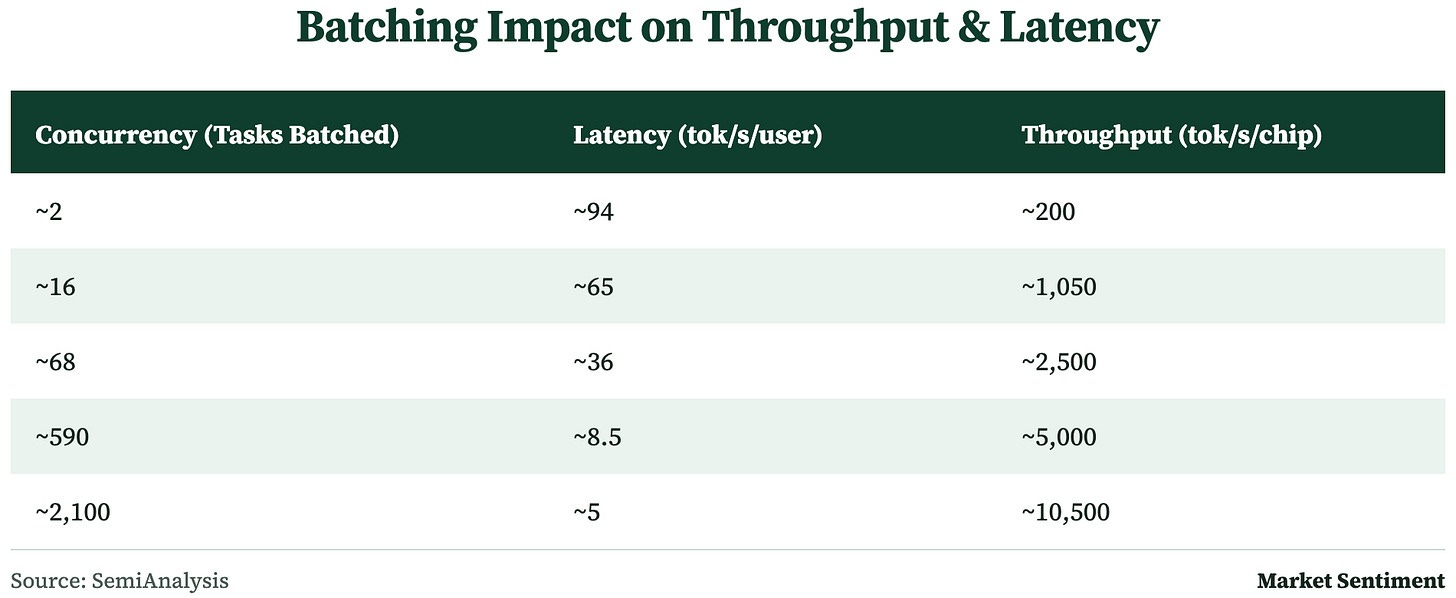
Batching. This packs more concurrent requests onto the same GPU. Each request waits longer as it goes through the batching process, but the GPU does far more total work per hour. This is why low-price hosts are often also slow hosts with higher latency.
The table below shows how latency changes with throughput for serving Deepseek V4 Pro on NVIDIA B300s. Throughput per chip rises ~10x while speed per user falls to ~1/13, as seen in the table below.
Software optimization. How well the software stack keeps the GPUs busy with custom kernels, speculative decoding, and request scheduling. Unlike the first two levers, a better stack buys speed without giving anything up.
In a closed model, the firm controls the weights and most parts of the serving stack together. Open-sourcing the weights will lead to the same model turning into ten products across a range of price vs performance specs.
How Open Models make money:
Most Open source software is actually free until you are not directly monetizing the software and using it for personal or internal applications. In case of open weight models, weights alone is not a product end user can use. They need AI inference infrastructure management expertise to run the model optimally.
Open labs give the model for free and will let an infrastructure ecosystem be built around the model with multiple companies competing to create a more optimized model serving stack while positioning across price vs performance spectrum.
Once an infrastructure layer is built around a model it becomes expensive to rebuild for a different one (harnesses, caching behavior, conversation-state assumptions, integrations).
As an open model’s volume scales, even a small fee produces meaningful revenue. Built-in switching costs from ecosystem fine-tuning to the model will ensure stickiness once a model scales, limiting market share loss to any new open-weight models.
Successful open-weight models with significant adoption are already playing the second stage, where they charge a fee for anyone selling their model. Moonshot’s Kimi K3 requires any model-as-a-service operator with revenue over $20M to sign a commercial agreement with a fee of up to 30% of revenue. Alibaba shipped its Qwen 3.8 model under a custom license that requires an agreement above $50M in revenue.
Why are Open models priced low:
Open models lag frontier models and have no pricing power. Lower price with a lower cost base is the only way to gain market share. To lower the cost base, Chinese open-source models tend to ride on the leading labs' research and use techniques like distillation, Mixture of Experts (MoE), etc.
Distillation: Frontier labs spend billions discovering what works through thousands of failed runs, human-annotated data, etc. Open labs compress that discovery process into training data by distilling frontier-model outputs. Anthropic has recently raised concerns about mass bot-driven distillation from a Chinese lab.
Architecture: Sparse MoE designs activate only a fraction of the total model parameters for each token. DeepSeek pioneered this approach, but labs now use it widely. Labs also use techniques such as FP8 training to reduce training costs with only marginal efficiency compromises.
Cheap training for a model means less needs to be recouped through inference to stay afloat. This makes aggressive pricing more sustainable. Further, Revenue = Price × Volume; a marginally lower price does not shift volume from frontier models to open-source models. To scale revenue, the only way is to price significantly lower to attract higher usage volume and drive higher overall revenue.
Open Source adoption and impact on AI ecosystem:
Open weights have overtaken proprietary models on the leading API platform OpenRouter. They now account for over 50% of all token volume on the platform, rising from ~33% in late 2025 and under 2% for Chinese open models in late 2024.
As per GS, open model API revenue accounts for <20% of total API revenue generated via OpenRouter. This large gap indicates API calls for open weights are largely driven by the lower end of the price-performance band, while proprietary models continue to lead in the higher price-spec category.
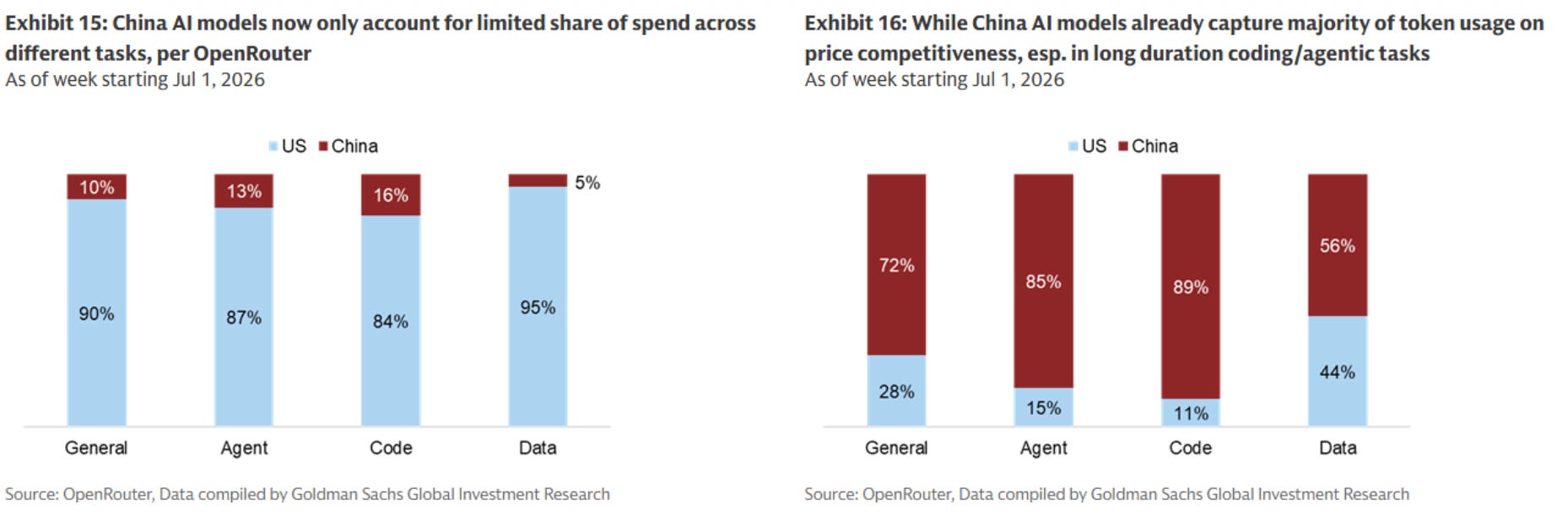
Latest US AI lab models GPT-6 Astra and Claude Fable 5.1 are priced at $10/$50 and $10/$50 per million tokens, in a similar band as GPT-4 ($30/$60) and Opus 3 ($15/$75) at the time of their release. For us, the key takeaway is that there is a separate market for leading specs, and AI labs can sustain their pricing in the market.
How AI labs and Infrastructure firms can respond:
What matters for AI labs is retaining and leading in $ market share. For now, their superior models are doing the job for them. However, we don’t think they will hesitate to change their business models if they see a threat to their $ market share.
If AI labs lose their model lead and begin to lose the premium market, we expect them to increasingly match open-source pricing and potentially move toward open-weight models themselves. OpenAI, for instance, has already open-sourced some of its models in the past; it released GPT-OSS in August 2025, its first open-weight model since GPT-2.
Lower AI token costs don’t necessarily mean AI labs will go bankrupt. Their underlying infrastructure and GPU costs are broadly similar to those faced by open-weight models. The bigger impact would be on margins and consequently, equity valuations. In other words, falling token costs are more likely to erode AI labs' valuations than to erode the value of the infrastructure investments that power AI.
Hyperscalers are model-agnostic infrastructure distributors. They already host multiple open-source models, including DeepSeek, Qwen, GLM, MiniMax, etc. Furthermore, AWS Bedrock and Google’s Model Garden allow enterprises to build their own models beyond simply using open-source models.
Irrespective of the model, hyperscaler platforms will continue to capture inference-servicing margins, with their edge being their ability to host thousands of GPUs efficiently by dynamically matching demand and supply. This frees enterprises from large upfront investments and continuous infrastructure maintenance requirements - essentially the same value hyperscalers have historically provided through the cloud.
Hyperscalers also benefit from export controls and regulations that require customers to run models within the US, limiting competition from China. That is why we continue to hold infrastructure firms and believe open source will not negatively impact them.
What we’re watching
History has run the open-source experiment before with two major products: Linux and Android.
In the early days of computing, multiple operating systems competed, including Unix, Microsoft Windows, and IBM’s OS/2. Linux differentiated itself not by being a simple, feature-rich operating system, but by being more customizable and adaptable to different applications. Over time, it built a large community and became the default open-source operating system. Microsoft retained its more lucrative consumer market through ease of use and a broader ecosystem, while sophisticated customers with specific needs moved to Linux. Most importantly, Linux succeeded while remaining free to use because the cost of developing and maintaining it was distributed across a large community.
Android took a different path. Google built an open-source operating system while retaining control over much of the broader ecosystem and monetizing services around it. This is broadly similar to the model companies such as Moonshot (Kimi) and Alibaba are pursuing with open-weight models today.
Open weights are currently a fast-moving market, with multiple Android-like systems emerging, but there is no equivalent Linux-like, community-driven system at the frontier. Truly community-driven models, such as AI2’s OLMo and EleutherAI’s Pythia, remain well behind the most capable models. The key barrier is training cost: Linux required distributed engineering effort, while training a frontier model requires GPUs worth millions of dollars. Community effort alone cannot easily fund these training runs, so most competitive open-weight models have a company behind them. Those companies ultimately have incentives to monetize the models or the ecosystems around them.
Either way, open weights limit AI labs’ pricing power by creating a wide range of price-performance options and making infrastructure increasingly important. Similar to operating systems, we expect the open-weight ecosystem to converge toward a few winners over time.
However, unlike operating systems, models are relatively cheap to switch between, so durable monopolies are harder to sustain, and leadership could continue shifting among a small number of winners. We will continue tracking token consumption and the number of infrastructure providers to understand where open weights converge and identify potential opportunities created by that convergence.
If you enjoyed this piece, PLEASE HIT THE LIKE BUTTON. It’s the only way new readers can discover our reports :)
Disclaimer: Market Sentiment work is provided for informational purposes only, is intended solely for readers in the United States, and should not be construed as legal, business, investment, or tax advice. You should always do your own research.
Really enjoyed this commentary. Learnt a lot in a manner I easily understood. Thanks a bunch.
The one thing I could not understand how you are going to track token consumption if openrouter is not enough representative for that. It is about up to 6% of total consumption, correct if I am wrong here, and users are predominately easy to switch between models, but there are enterprises that stick to one AI model