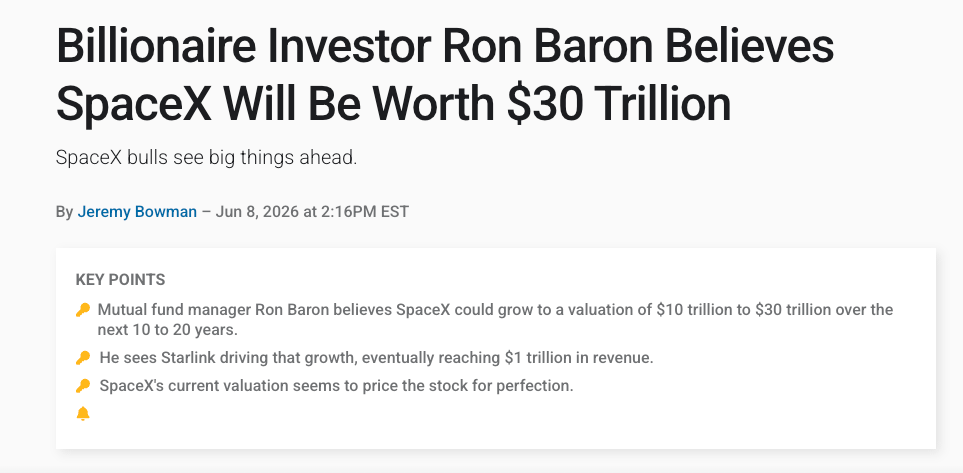
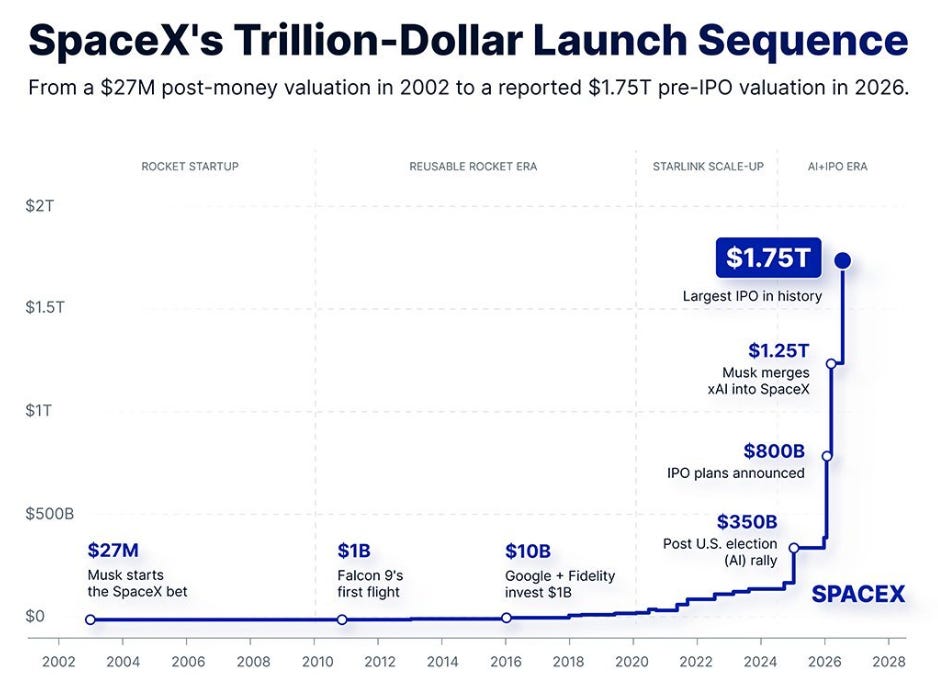
What we have noticed with the SpaceX IPO is that there is no middle ground. Either you are in “SpaceX is going to be the biggest company ever.”
or in the “there is no rational reason for you to pay ~100x revenue multiple for a loss-making company.”
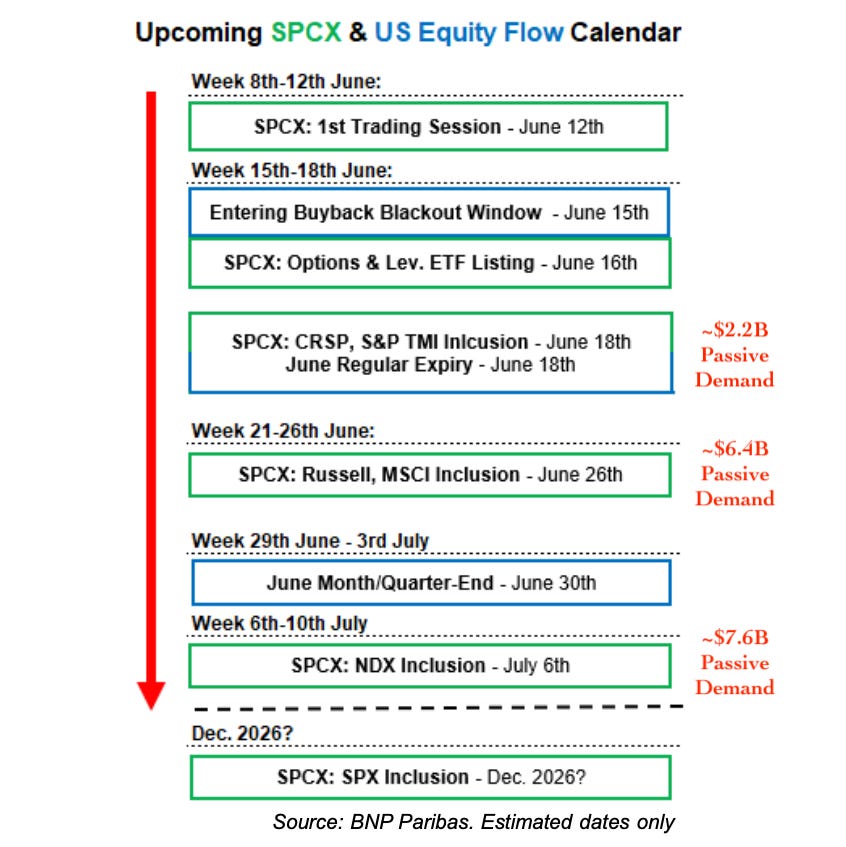
But what if there was a middle ground? What if you could trade this IPO without ever buying the trillion-dollar story? The setup is in the mechanics, not the fundamentals, and that's what we are going to find out today. But before we get there, let’s take a closer look at the company and how they make money.
Business Overview
While you can read the full 400-page prospectus here, SpaceX has 3 main business segments:
Space — sells launch services. Revenue comes from two streams: (i) Launch Services, deploying payloads to orbit for commercial and government customers on the reusable Falcon 9 and Falcon Heavy, and (ii) Launch and Development, building spacecraft and providing launch/mission services for government space programs (Falcon 9, Falcon Heavy, Starship, and Dragon).
Connectivity — is the Starlink business; revenue comes from broadband and Starlink Mobile service across 156 markets, split into Consumer Broadband, Enterprise Solutions, Government Solutions, and Mobile.
AI — is the newly acquired xAI/X business. Revenue comes from advertising on the X platform plus AI solutions and infrastructure: subscriptions, data licensing arrangements (access to X's real-time and historical data), and API access to the Grok models.
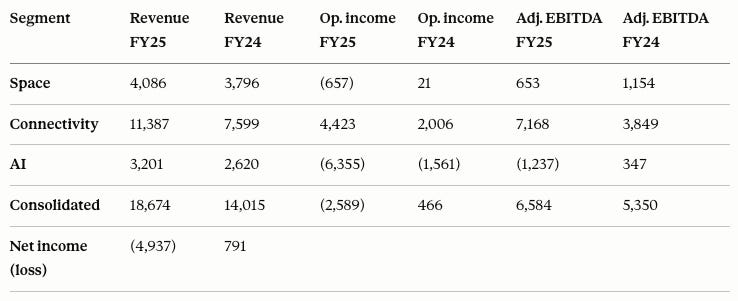
Looking at the numbers,
Starlink is the strongest business where revenue grew ~50% ($11B now), operating income more than doubled, and adjusted EBITDA rose 86%.
Even though revenue improved for launch services, operating profit flipped from $21M profit to $657M loss — the driver here is Starship development, which increased R&D costs from $1.7B to $3B.
AI revenue grew 22% (arguably small base of $2.6B), but now the operating loss is $6.3B. Once again, R&D is driving losses, as the company spent nearly $5B on training the Grok model and building out AI compute capacity.
This also allows us to build a rough valuation model to assign a value to each division.
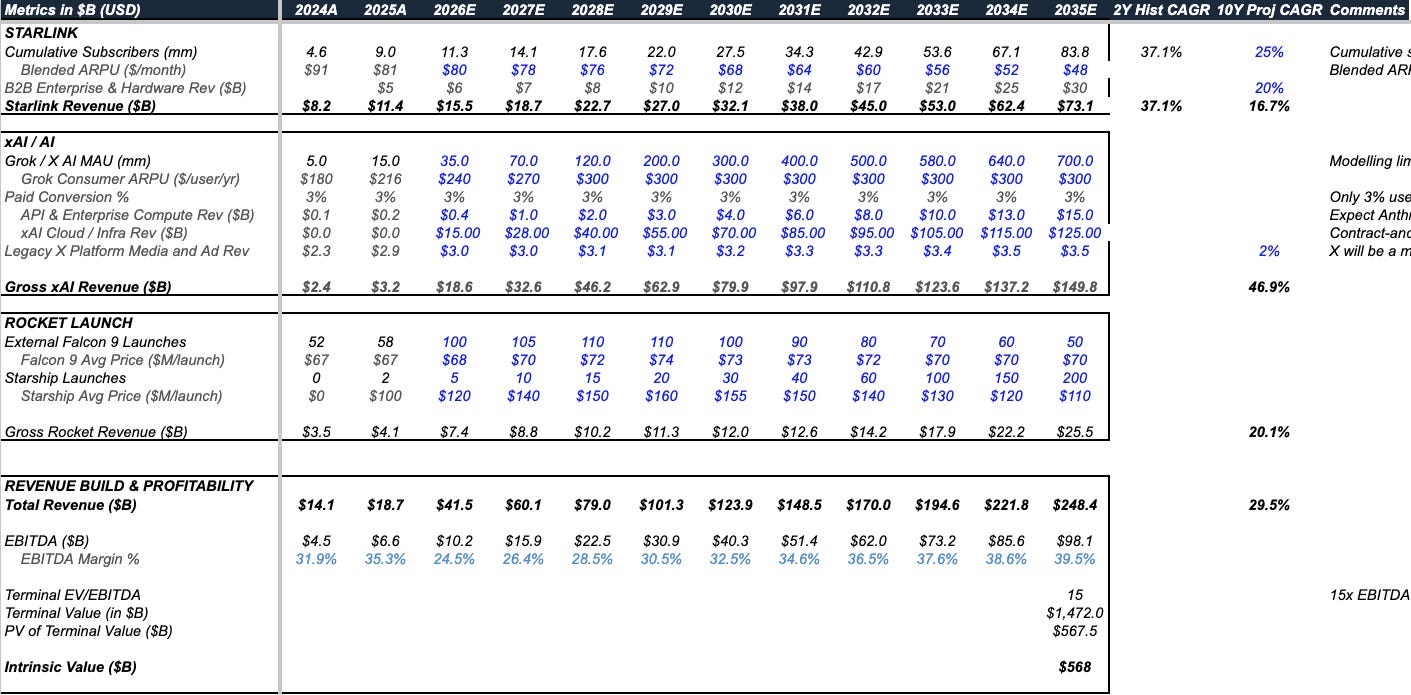
Here’s how the numbers look:
Starlink — We modeled subscribers to grow at a 25% CAGR from 9 million in 2025 to 84 million by 2035, a number that only holds if direct-to-cell scales alongside fixed broadband. Blended ARPU falls from $81 to $48 a month, because cheap direct-to-cell plans dilute the premium home base. At a blended 15x multiple, it carries $167 billion in intrinsic value.
Launch Services — External Falcon 9 is anchored to third-party demand, near the 58 launches seen in 2025, rising into the late 2020s then declining as Starship absorbs the heavier external missions. Assuming a successful transition to Starship, modeled revenue reaches $25B by 2035, bringing the valuation for launch services close to $60B.
xAI / AI — is the big gamble. As of now, the numbers are based on real contracts, but we are assuming a growth rate of nearly 50% for 10 years. 80% of the 2035 revenue comes from contracts that do not exist yet. Even with this optimistic projection, AI will add only $343B in value.
What’s interesting is that even with the most optimistic projections for each business segment, the company's total value comes to only $568B ($43 per share), a far cry from the asking price of $1.75 trillion ($135/share).
The kicker? If you exclude the AI division, the company's total value is around $220 billion — which is what it nearly traded at in private markets before the IPO hype and the xAI merger.
How to trade the world’s largest IPO?
While by valuation, SpaceX will be listed among the top-10 companies, it will trade like a mid-cap due to its small float. Broadcom, which is similar in size, has $1.7T in tradable float compared to only $75B for SpaceX.
Now that we know that the stock is going to be volatile and priced way above what it should be priced at by any reasonable estimates, here’s how you can trade it (based on whether you got the IPO allocation or not)