


The funniest things happen in the AI world. While OpenAI and Anthropic were busy fear-mongering about AI destroying humanity, Meta just dropped Muse, an always-on personal AI assistant for everyday tasks.


The everyday bit is the important piece. Till now, AI usage was limited to replacing a Google search with an AI summary, quick troubleshooting, or something work-specific. With Muse, Meta became the first company to bring agentic AI into the mainstream. Within two weeks of launch, consumers have used Muse to
Book a haircut with your traditional constraints
Wait on hold till customer support picks up
Cancel insurance
Schedule an IKEA return
And it pulls this off while looking like a cute little gizmo. This means Muse has now climbed to the No. 1 spot among free apps on Apple’s US App Store, ahead of ChatGPT.
Overnight, Meta went from a company that knew your social media preferences to one with access to your email, calendar, Amazon, and pretty much everything else. Meta is the obvious story here, and we will get to it. The bigger one is what happens to everything else once agents go mainstream.
Tough time to be an intermediary
When you think about it, a lot of multi-billion-dollar companies exist just to reduce friction.
90% of business TurboTax does is simple tax filing.
Booking Holdings pays Google to redirect people to use its travel comparison.
Fiverr exists so that you can outsource boring, data-intensive tasks to the third world.
Now what happens in an agentic world? What if Muse is capable enough to get all the details to file your taxes? Two weeks after launch, it’s already capable enough to book flight tickets and even get a credit from Delta for a delayed flight. Imagine how much more capable they'll be 2-3 years from now — ChatGPT didn't have live internet browsing three years ago.
And it isn't only thin-wrapper companies at risk. Even Amazon is concerned, and they blocked access to Meta’s Muse last weekend. The logic is simple. No one wants to get commoditized. If I ask my agent to get something via Amazon, Amazon loses the ad revenue it collects while I browse for the product. And it’s no small change: Amazon made ~$70B last year from its ad business, and it’s near-pure profit that hits the bottom line.
Changing Business Models
Beyond the intermediaries, even legacy companies will struggle in an agentic world.
Moving your bank deposit is annoying, but what if the agent is reliable enough to sweep the idle cash to the highest-yielding account? Also, even a half-decent agent will significantly reduce the $12B a year in overdraft fees paid by inattentive customers.
An assistant that shops around for the best insurance rate instead of auto-renewing at a slightly higher price will be a massive hit on the insurers. Also, what happens if your agent fights every single denial on your insurance that you were too lazy to fight?
Even Google search might come under pressure — Google monetizes the results page and gets paid when you click a link. You can argue that Google can create its own agent layer, but monetizing it will be a completely different challenge. Can an agent redirect you to a sponsored listing smoothly without triggering FTC rules?
It’s estimated that 1/3rd of the loyalty points are never cashed in. Personally, while my AmEx points continue to accrue, I have never bothered to redeem them when booking something because of the hassle. How much more usage would the industry see if agents started optimizing the booking and payment processes?
The trick here is that there are no free lunches. Meta is giving unlimited access to Muse right now because they are in the data collection and customer acquisition phase. Every dollar you save using an agent, or every hassle it removes, is a small lever to keep you on the same platform or turn you into a paying customer.
Which brings us to:
Why is it good to be Meta right now?
As we highlighted last week, platforms with a large consumer base stand to benefit the most as agents go mainstream. And there’s no larger consumer platform than Meta. The stock is up 30% in the last month and has added nearly a quarter of a trillion dollars in market cap after the launch of Muse.
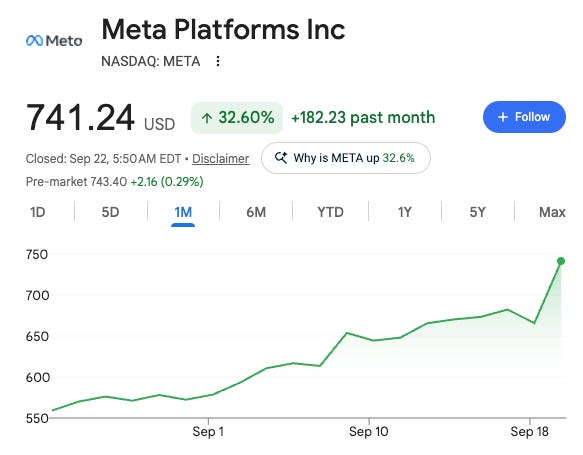
Even after the current run-up, we believe Meta is undervalued based on these 4 factors: