


The most crowded trade in the market
To say that the AI trade has become consensus would be the understatement of the year. Look at the top 10 performers in the S&P 500 this year. Except for Moderna, every other company on the list is an AI infrastructure provider.
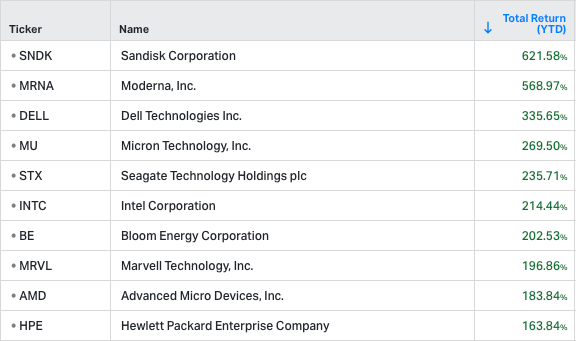
The media and Wall Street keep talking about these companies because it brings eyeballs, and ever-rising capex projections make them look like a great deal. But this is exactly why 95% of fund managers end up underperforming the market.
They buy high as the crowd comes in and sell low at the bottom, because none of them want to stand out by being contrarian. Your job is safe if you’re wrong with everyone else. It isn’t safe if you’re wrong while everyone else makes money.
We don’t have that problem. We answer only to you, our readers. And our own money sits in the Market Sentiment portfolio alongside every call we make. When it wins, we win. When it’s wrong, we lose too.
The easy thing would be to keep covering the bottleneck trade after being up 64% YTD. But we are doing the opposite. By the end of this letter, you’ll know why, and where our money is going next.
Why we are rotating
Let’s get one thing out of the way. We are not AI bears.
Our portfolio is up 64% this year on the AI build-out. Most of that came from the AI infrastructure trade: memory, advanced packaging, and optics. We wrote about those bottlenecks before they were consensus.
Now they are consensus. That’s the problem.
You know what happens after a trade has become consensus? Mean reversion.
We have done extensive research on what happens when you invest in previous winners, and the results aren't great.
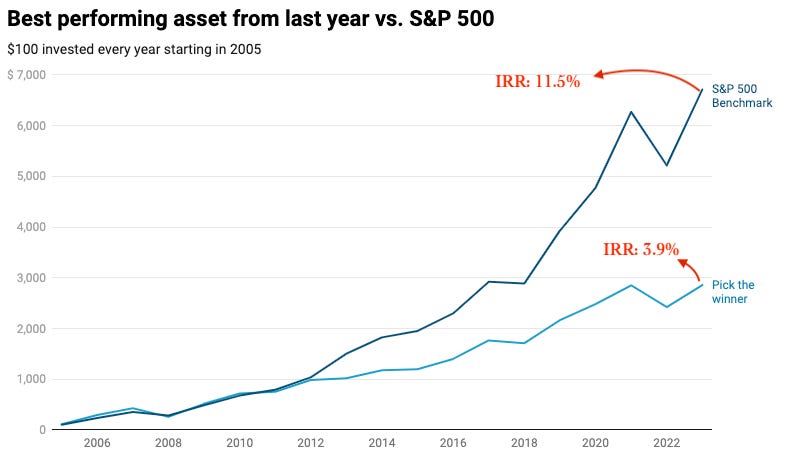
An asset that goes up suddenly tends to mean-revert. Blindly buying the losers didn’t work either. Being contrarian isn’t enough. You need a reason the next winner will win.
The rule everyone forgets
The industry that creates a technology rarely captures the value it creates.
> Cisco built the internet’s plumbing, but Amazon made the most of it.
> AT&T laid the fiber, but Netflix is now worth nearly twice as much.
> IBM built the PC, but Microsoft owned the profits.
> Railroad companies went bankrupt but Sears turned it into a mail-order empire.
The examples are endless, and the cause is always the same. Build-outs attract too much capital. Everyone builds at once, so capacity overshoots demand and prices collapse. The builders are left holding expensive assets that earn commodity returns.
The companies downstream get the opposite deal. Their most important input just got cheap. They own the customer. And someone else paid for the infrastructure.
The lasting winners in AI will be the companies building on top of the infrastructure, not the ones laying it down.
The question you should be asking
If Intelligence becomes abundant and cheap, who stands to benefit?
For the same level of performance, the price of AI has fallen roughly 1,000x in three years. The models kept getting smarter.
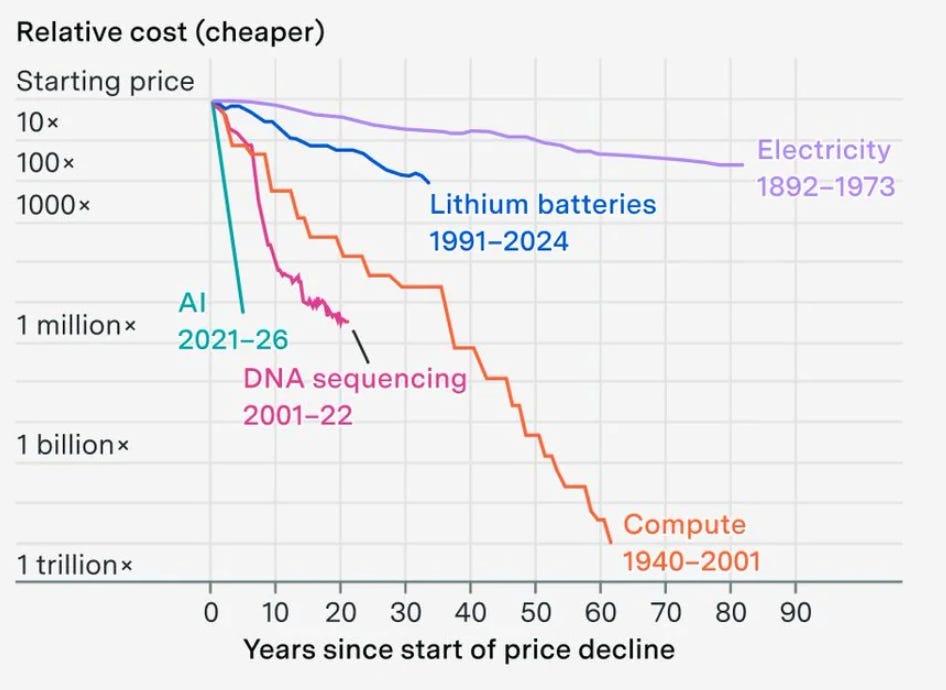
When intelligence gets 1,000x cheaper, the value doesn’t disappear. It moves downstream, to the companies that turn cheap intelligence into something customers will pay for.
Here’s our map of where we will be rotating our capital to:
Margin Expansion — Last quarter, 25 S&P 500 companies said AI will lift their margins by 180 basis points on average. Even garbage haulers are seeing it: Waste Connections says its AI pricing tool already adds about $20 million a year to EBITDA.
Cybersecurity — Frontier models just handed a mediocre hacker the coding ability of the top 1%. Companies can’t ban AI, so they’ll pay for guardrails.
Cheap Compute — Writing an email doesn’t need a frontier model. Serving intelligence is becoming a race to the lowest cost per token, and that race will be fought on custom chips.
Development Infrastructure — As the cost of building software falls to zero, a lot more applications will get built. As more applications are built and deployed, the infrastructure and tooling needed to develop, connect, secure, and operate them should grow with them.
Attention — AI gets better with more user data. The largest consumer platforms turn that into better recommendations and better-performing ads.
Why the window is short
On September 16, the Fed raised rates for the first time this year, to 3.75% to 4.00%. Most FOMC members expect one more hike before December. Fed Chair Kevin Warsh put it plainly: inflation “is too high and has been for too long.”
The Fed’s 25bps hike isn’t the real worry. The combination is: a new, hawkish Fed chair, sticky inflation from tariffs and the Iran war, and rising national debt.
Semiconductor stocks are sensitive to rate hikes, and they’re the most crowded trade in the market.
They’re priced on the far future. A chip stock trading on 2028 earnings is a long-duration asset. When rates rise, those distant profits are worth less today, and the richest valuations fall hardest.
Their customers are borrowing to buy. Goldman Sachs expects about a third of hyperscaler capex to be debt-financed in 2026. Every hike makes the next data center more expensive to build.
The market is already repricing that debt. Of 91 hyperscaler bonds issued this year, 78 were trading at higher yields in late July than when they were sold.
One company’s chip revenue is another company’s capex. When borrowing gets more expensive, the pressure lands on capex budgets, and chip orders sit inside them. We’ve seen this before. In 2022, as the Fed hiked, the Philadelphia Semiconductor Index fell 36%, nearly double the S&P 500’s loss.
That’s exactly why any blip, however minor, can erase years of gains.
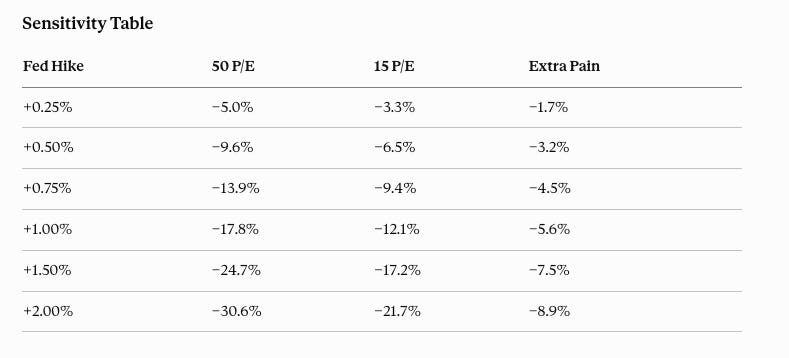
The companies downstream don’t carry that debt. Their most important input keeps getting cheaper while the builders pay for the build.
Who we are
Market Sentiment is one of the top finance publications on Substack, read by more than 67,000 investors with thousands of paid subscribers. We were one of the first to cover the energy trade, the optics trade, and advanced packaging.
Each time, we were early. That’s the edge Pro subscribers pay for. We show our work. Every model, every source, every position. No “#1 stock to buy now.”
Here’s what readers say:
This is easily the most evidence-backed, not click-bait, not “#1 Stock Now!” investing information I’ve found. I value supporting that. — Jerome Steckler
A must-read for any investor — Graham Stephan, #1 Finance Creator on YouTube
As a financial advisor, I value your research, insight, and the stories you convey. Thank you! — Michael Bird, CIMA®, AIF®
Try Market Sentiment Pro for 14 days
We don’t want you to take our word for any of this. See the research and judge it yourself.
Start a 14-day trial of Market Sentiment Pro, and you get:
Access to all our reports: The full archive, including our deep dives on energy, optics, and advanced packaging, plus every new report as it lands.
The complete portfolio. Every current position, including the holdings behind this year’s 64%.
Access to the team and the subscriber chat.
Here’s how it works. Your trial runs for 14 days. You will get four new reports over the next two weeks, including two stock deep dives. If you cancel before it ends, you pay nothing. If you stay, you’re billed $497 for the year.
$497 a year works out to $1.36 a day.
Put it next to what’s at stake. If you hold $50,000 in AI stocks, a 10% pullback costs you $5,000. That’s about ten years of Market Sentiment Pro.
Now flip it. If you had started tracking the MS portfolio with $50,000 at the start of this year, it would already have paid for about 64 years of Market Sentiment Pro :)
You can keep owning the railroad. It’s been a great ride, and it may have further to run.
Or you can position for what history says comes next: the companies that use the rails, own the customer, and turn cheap intelligence into durable margin.
We’re making that move now. We’d like you to see it with us.
Thanks,
MS Team
Disclaimer: Market Sentiment work is provided for informational purposes only, is intended solely for readers in the United States, and should not be construed as legal, business, investment, or tax advice. Portfolio performance of 64% is as of 30th Sep 2026. Past performance does not guarantee future results. You should always do your own research.