


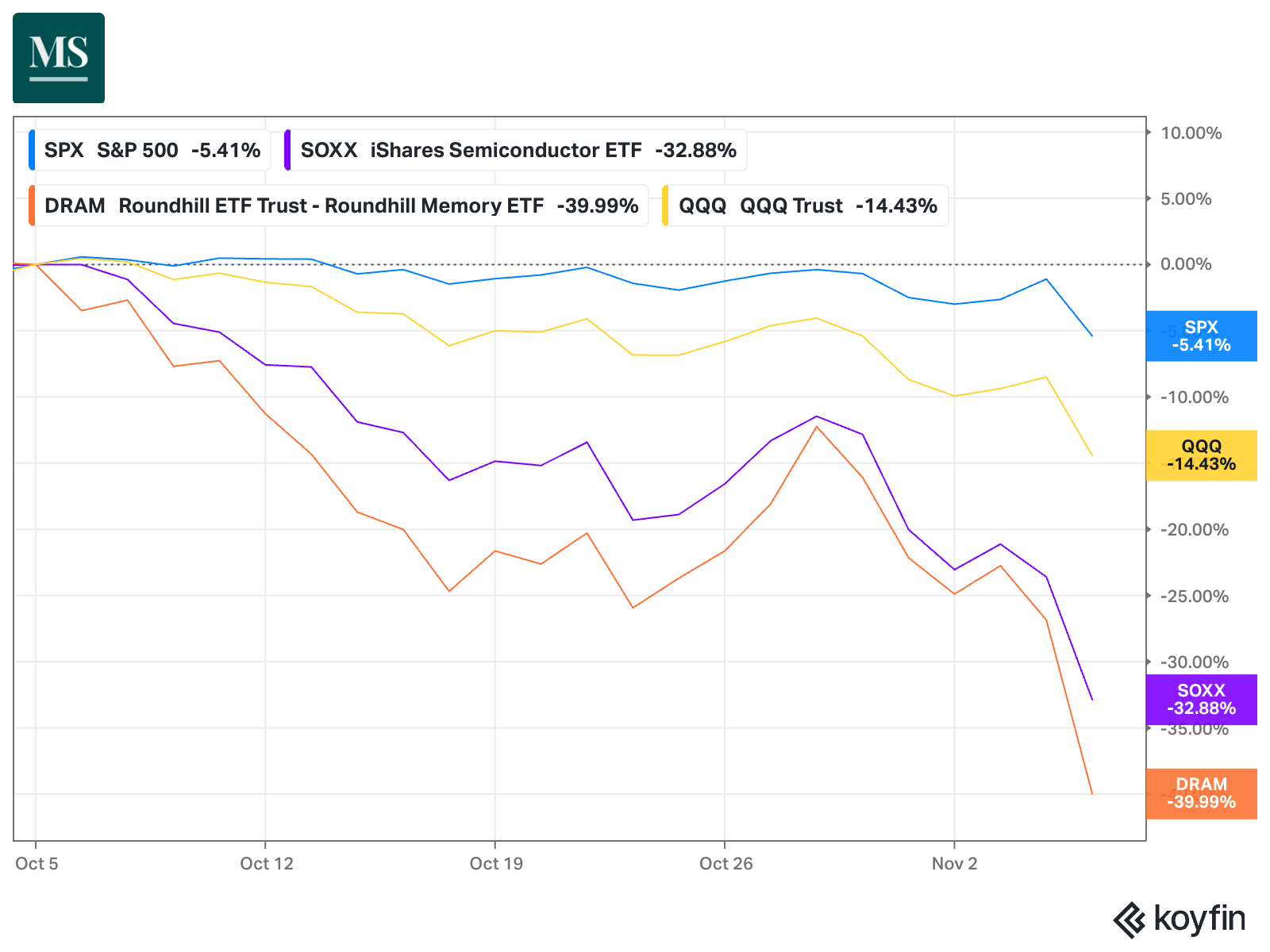
Market conditions are really tough across the board. Over the last month, the S&P 500 fell 5%, the Nasdaq fell 14%, and the memory ETF is now down 40%!
As we discussed a few days ago in our portfolio update, the most important thing during periods like this is to return to your initial thesis for investing in the company and see whether anything has changed fundamentally.
Quick notes on the crash and how we are positioning before we get into Alphabet (which is now in bear market territory after a 30% drop).
The idea that the election results are going to significantly curtail AI buildout is pure panic. There will be extra regulations, for sure, but nobody reasonable will be willing to hand the lead to China. Plus, companies can always shift data centers outside the U.S. It’s similar to the panic when DeepSeek launched last year (Nvidia dropped 17% the next day, but you don’t remember it now).
Getting out of AI now and then rotating into consumer staples like Walmart (P/E 46) and Costco (P/E 51) is not a great strategy. If that was your plan, you should have done it 6 months ago, not now, once the stocks have re-rated. You are just selling low and buying high.
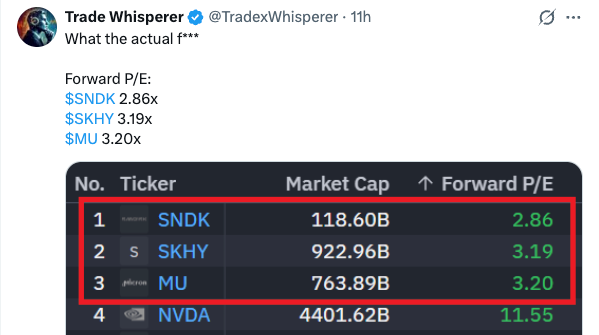
On the other hand, there are a lot of accounts fixated on the low Forward P/E of memory stocks and how you should double down. What they are missing is the unpredictability of “E”—the long-term agreements for memory mean nothing if the sentiment changes and memory prices crash. For example, most of the contracts with SK Hynix and Samsung rest on a 10 to 30% prepayment. In a market where memory prices crash 50% or more (like in 2019 or 2022), forfeiting the prepayment by reneging on the contract and buying the memory on the open market is more profitable for the buyers. This has happened before, and it’s exactly why memory is trading where it is.
Finally, here’s what we predicted two months ago in September.
Successful investing comes down to finding a trend early and knowing when the thesis has become consensus. It’s the second part that trips up so many investors. While riding the trend up, it’s easy to think that it’s going to run forever. All the data and analyst projections point that way. But that’s rarely the case.
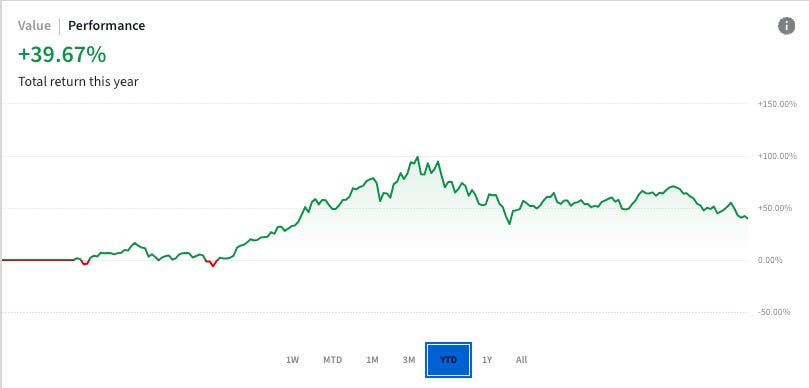
Right now, that is the AI infrastructure trade. Capital has crowded into a handful of winners, with valuations increasingly pricing in years of uninterrupted growth. While this has certainly helped our portfolio (+55.3% YTD), many of the obvious AI bottleneck trades have already become consensus.
We are bullish on the ROI AI capex will generate, but skeptical about how much projections will rise next quarter, especially since the ones running the show are clamoring to slow development. Any blip, however minor, will erase years of gains from these stocks.

While we rotated some of our capital from the pure AI trade into AI beneficiaries, we still have ~20% allocated to memory, ~15% to advanced packaging, and ~20% to ASICs. The portfolio impact would have been lower if we were more aggressive with the rotation, but hindsight is 20/20. For transparency, the MS portfolio is down 17% last month vs. -15% for QQQ and -33% for SOXX. YTD, we are up 40%.
What’s going on with Alphabet GOOG 0.00%↑
Google is now down 18% in the last month, with the company dropping nearly 13% after earnings, its worst day since going public in 2004, wiping out nearly half a trillion in market value.
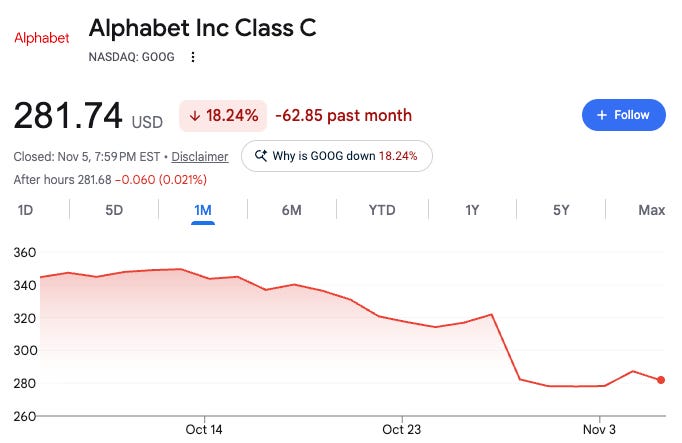
Unlike yesterday’s crash, this one was not driven by sentiment. Google reported a slowdown in search revenue growth.
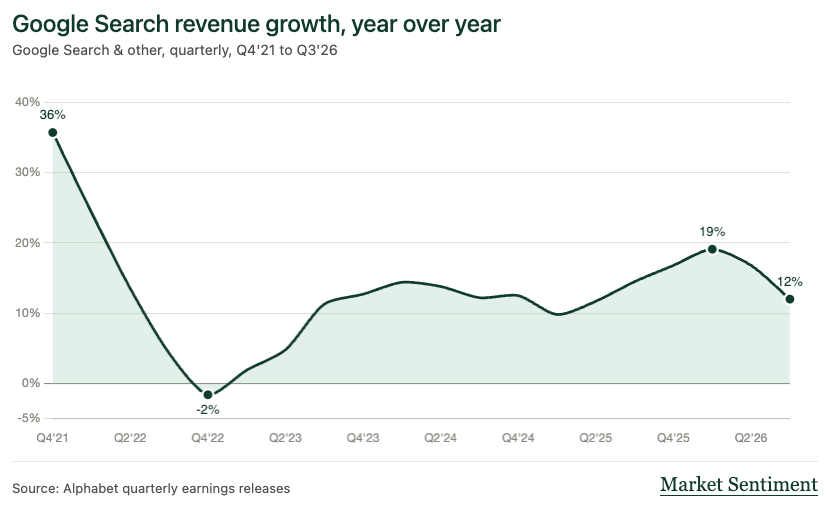
Management attributed this mainly to currency effects (half of Google’s revenue comes from outside the US, and the USD strengthened against other currencies last quarter).
The line that caused the most damage came from Google’s Chief Business Officer, Philip Schindler.
It’s worth noting that the strong growth in AI Mode queries had an impact because of the lower monetization we were seeing in AI Mode. To be clear, we feel very good about our trajectory here.
Basically, this is the bear case for Google that all the AI optimists have made since the launch of ChatGPT. Until now, when you searched for something on Google, the first few links were well-placed ads, and Google got paid every time you clicked one. But with AI Overview (the following are MS assumptions and not management commentary),
The number of clicks has reduced since you get the answer directly
No one has come up with an effective strategy for advertising inside AI mode and earning comparable to search.
That’s the issue. Investors are expecting that Google Search is going to face increasing headwinds, and the replacement in the form of AI Overview cannot monetize effectively.
On the other hand, Google Cloud is on a generational run, and it grew a mind-bending 103% on a $15B base. How many other multi-billion-dollar businesses do you know that have doubled in one year?
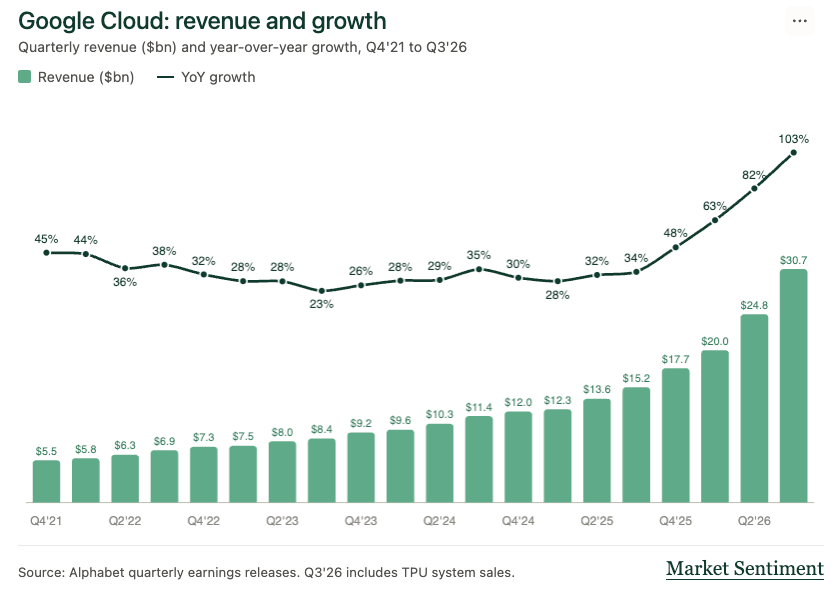
The billion (trillion?) dollar question then is whether the growth in cloud revenue can offset whatever Search revenue slowdown Google might face in the future. If yes, then the current drop makes it an attractive entry point.
To find out, we can build a simple sum-of-parts DCF model. We will build separate valuation models for Search and Cloud, then assign a value to each. Then, we can build base, bull, and bear cases for each segment to see whether cloud growth can offset a slowdown in Search.
How much is Search and Cloud worth today?
GOOG 0.00%↑ is currently trading at $281 with a market cap of $3.5T.
Let’s start with Search.
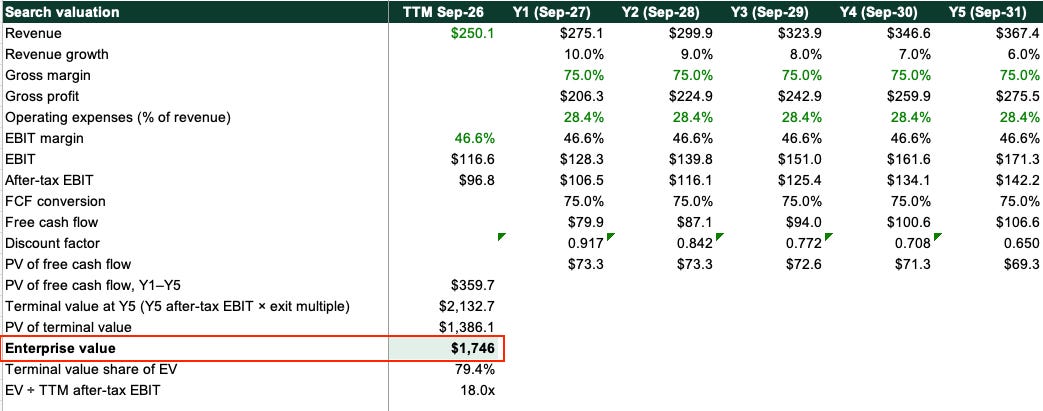
If you're not familiar with DCF, don’t be intimidated by all the numbers. Here, we're building a base case for how much Google Search would be worth to the company if it continues growing at 10% next year and slows to 6% by the end of the decade.
FYI, RC has a great guide on valuing companies.
In the base case, we are assuming no significant disruption from AI and also no boom, just a gradual slowdown due to the base effect. For simplicity, we keep the gross margin at 75% and the operating margin at 47% (based on historical trends).
Long story short, we can value Google Search at $1.7 trillion, or roughly 50% of Google’s current market cap. (Full model available as an Excel file at the end if you want to play with the assumptions)
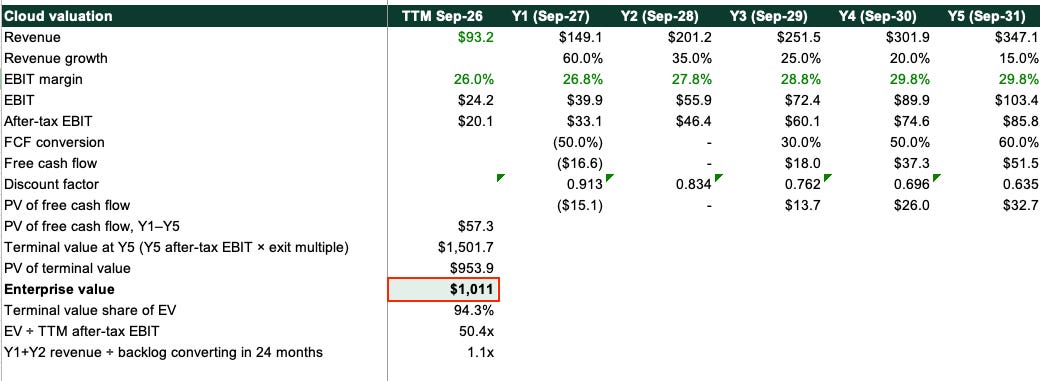
Cloud is trickier because it’s growing much faster than Search. In our base case, revenue grows 60% next year, then slows to 15% by 2031, rising from $93 billion to about $347 billion. Google has $561 billion in signed contracts, enough to cover nearly 90% of the next two years’ revenue. Margins improve slightly with scale, from 27% to 30%.
That brings the Cloud valuation to ~$1 trillion today.
One caveat: because Cloud is growing faster, 94% of its value comes from the 2031 exit vs. only 79% for Search.
Putting it together, even though the parent company Alphabet has 100s of products varying from Waymo to YouTube to DeepMind, ~80% of the enterprise value comes from Search and Cloud, and that’s exactly why this will make or break the company.
Can Cloud growth offset a Search decline?
Now that we have the model, we can get to the fun part.
Is the current drawdown justified? At what pace of Google Cloud growth can it offset a decline in Google Search?
Let’s dig in: