


No paywall on this one. Share it with a friend :)
The elephant in the room in every AI discussion is whether hyperscaler capex is sustainable. The bulls are happy as the numbers keep getting revised higher every quarter.
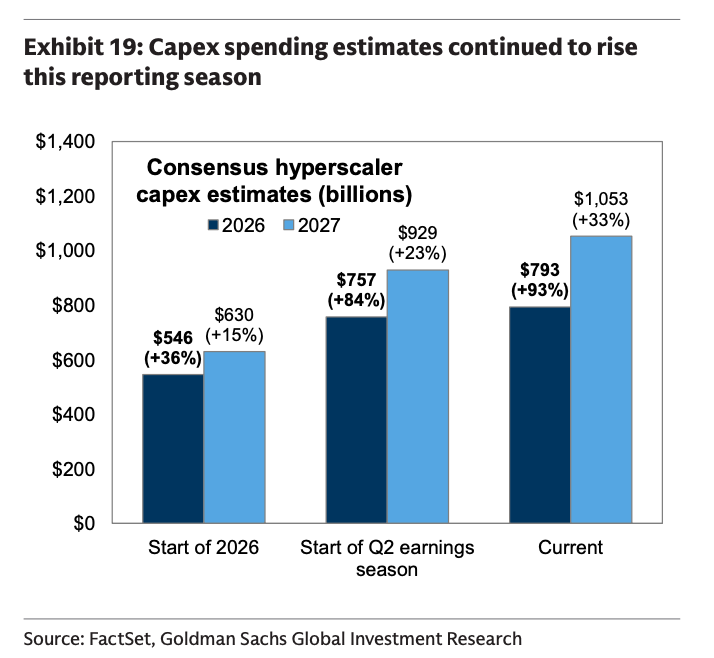
On the other end, bears look at the $1T number and call it unsustainable.
What surprised us is that we couldn’t find anyone who actually worked through the numbers to figure out who’s right. While certainty is impossible in investing, just like building a DCF model, working through the numbers gives us a plausible estimate of what conditions are needed to sustain the current spending.
This is crucial as nearly 80% of the Market Sentiment portfolio and ~50% of the S&P 500 is directly exposed to AI or AI-adjacent spending. Any pullback here will bring a brutal drawdown.
So get a cup of coffee and let’s dig into what is probably the most important investing question of the decade! To answer this, we need to model
What goes into a datacenter, and how long it lasts.
What the new capacity earns, and for how long.
What’s the running cost, and how would the margins evolve over time?
Join 46,000 other investors to make sure you don’t miss our next briefing.
What goes into an AI datacenter?
Today, a 1GW datacenter is expected to cost ~$40B. This capex splits into two categories defined by asset life.
1. Chips — compute and memory
Traditionally, chips last 5 to 6 years, after which a more efficient generation makes them uneconomic to run, and reliability begins to drop. While cloud companies are trying to extend this life by moving older chips to lower-intensity inference workloads, for our model we are assuming a 5-year life (more on this later).
CoreWeave’s A100s (a 2020 release) are still fully booked, and a batch of Nvidia H100s (2022) that came off contract was immediately re-let at ~95% of the original price. CoreWeave CEO Mike further noted (Q1 2026) sustained pricing across the older fleet as inference pushes demand up for the older-generation devices.
2. Datacenter shell — building, power equipment, networking
The useful life of buildings runs up to 30 years. Google commented on its recent earnings call that ~60% of capex went to servers and ~40% to datacenters and networking equipment. The shell’s share of the mix has come down from ~50%+ a few years ago as semis have become more expensive.
Given rising prices with each new GPU generation, we assume a semis-to-shell capex ratio of 2:1. So for every $100B spent on a new datacenter, $67B goes to chips and $33B goes to the shell.
We take the top-of-the-range shell life because the shell is chip-agnostic. The building, power, and cooling serve successive generations of chips without major changes. Also, the permitted sites are one of the scarcest assets in the buildout, and the owners would want to push as much mileage out of them as possible.
This capex drives the entire AI semis complex. Microsoft, Amazon, and Google plan to spend ~$600B on capex in 2026, versus ~$300B in 2025. This spending gets redirected one way or the other into the chip side (Nvidia, AMD, TSMC, SK Hynix, etc.) and the shell side (Vertiv, GE, Schneider Electric, Caterpillar, etc.).
What the capacity earns?
A datacenter earns by renting compute. Two variables set that revenue: how much of the capacity gets rented, and the rate per GPU-hour.
The first bit is easy for now: all data points to the fact that capacity is sold before it is even built. AWS backlog reached $496B in Q2 2026, and Amazon has said the lion’s share of its 2027 capacity is already reserved. Every other hyperscaler shows the same trend. Microsoft closed June 2026 with $678B of commercial RPO, up 84% year over year; Google Cloud’s backlog hit $514B in Q2 2026, up more than $50B in a single quarter.
The rate per GPU-hour is the tricky bit, as it keeps falling as the GPU ages. For example, the one-year committed pricing for H100s has fallen from ~$3.00 to ~$1.80-2.40 per GPU-hour over three years.
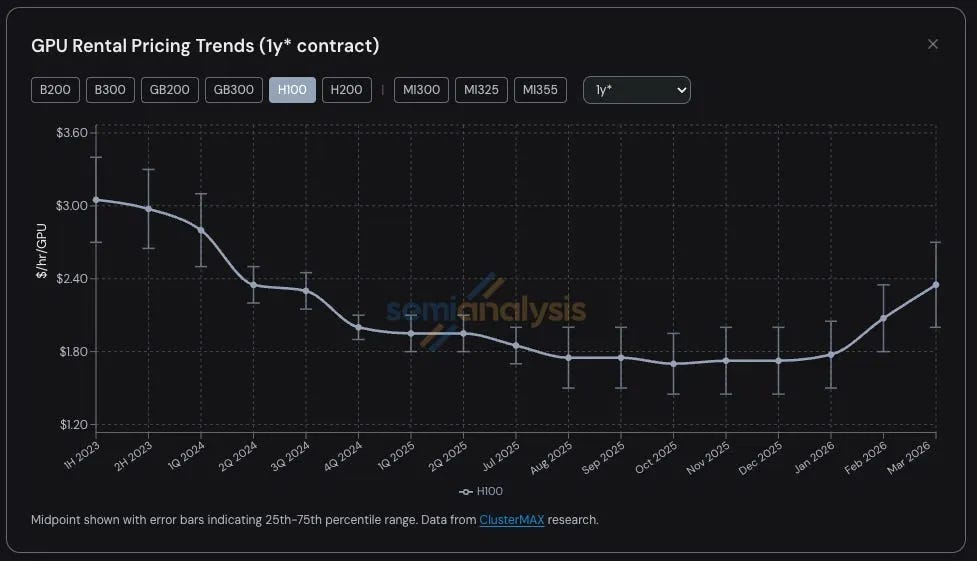
The average H100 rental rate over its first three years was ~$2.25/hr. At 90% utilization, that is ~$18k of revenue per GPU per year. A $100B datacenter puts ~$67B into chips at the 2:1 ratio, which at ~$32k per H100 buys ~2.1 million GPUs.
So roughly, a $100B datacenter will generate ~$37B of revenue a year over its first three years.
What it costs to run?
A datacenter has two major operating costs: energy and maintenance.
Electricity: Datacenters are measured in power; as the name suggests, a 1 GW datacenter consumes 1 GW of power. But there are efficiency losses between power drawn from the grid and power actually used by the compute, measured as PUE (Power Usage Effectiveness). Datacenters have an estimated PUE of 1.14, so a facility with 1 GW of IT load draws 1.14 GW from the grid. Assuming a compute utilization rate of ~90%, total annual consumption comes to 1 GW × 90% × 1.14 × 8,760 hours = 8,987 GWh (~9.0 TWh).
US average industrial power cost is 8.66 cents per kWh as of April 2026, or $86,600 per GWh. Datacenters are built where power is cheapest, with low-cost states running below that; for our model, we assume the US industrial average. This gives a total power cost of 8,987 GWh × $86,600 per GWh = $778mm, or approximately $800mm per year for a 1 GW datacenter at a 90% utilization rate.
Maintenance: Maintenance costs are primarily spread across property taxes, labor, and repair work. As per Epoch AI, average maintenance for a 1 GW datacenter stands at ~$300mm across these three categories.
So, all in, the annual cost of running a 1 GW datacenter stands at ~$1.1B with $800mm in energy at today’s prices and $300mm in maintenance. As per a Morgan Stanley report, this can go as high as $2B depending on power costs and property taxes at the location. For our model, we will be conservative and take $2B as the annual cost of operating a 1 GW datacenter.
A 1 GW datacenter is estimated to cost ~$40B to build. With $100B in capex, we can build 2.5 GW, leading to total operating costs of ~$5B per year.
The Model
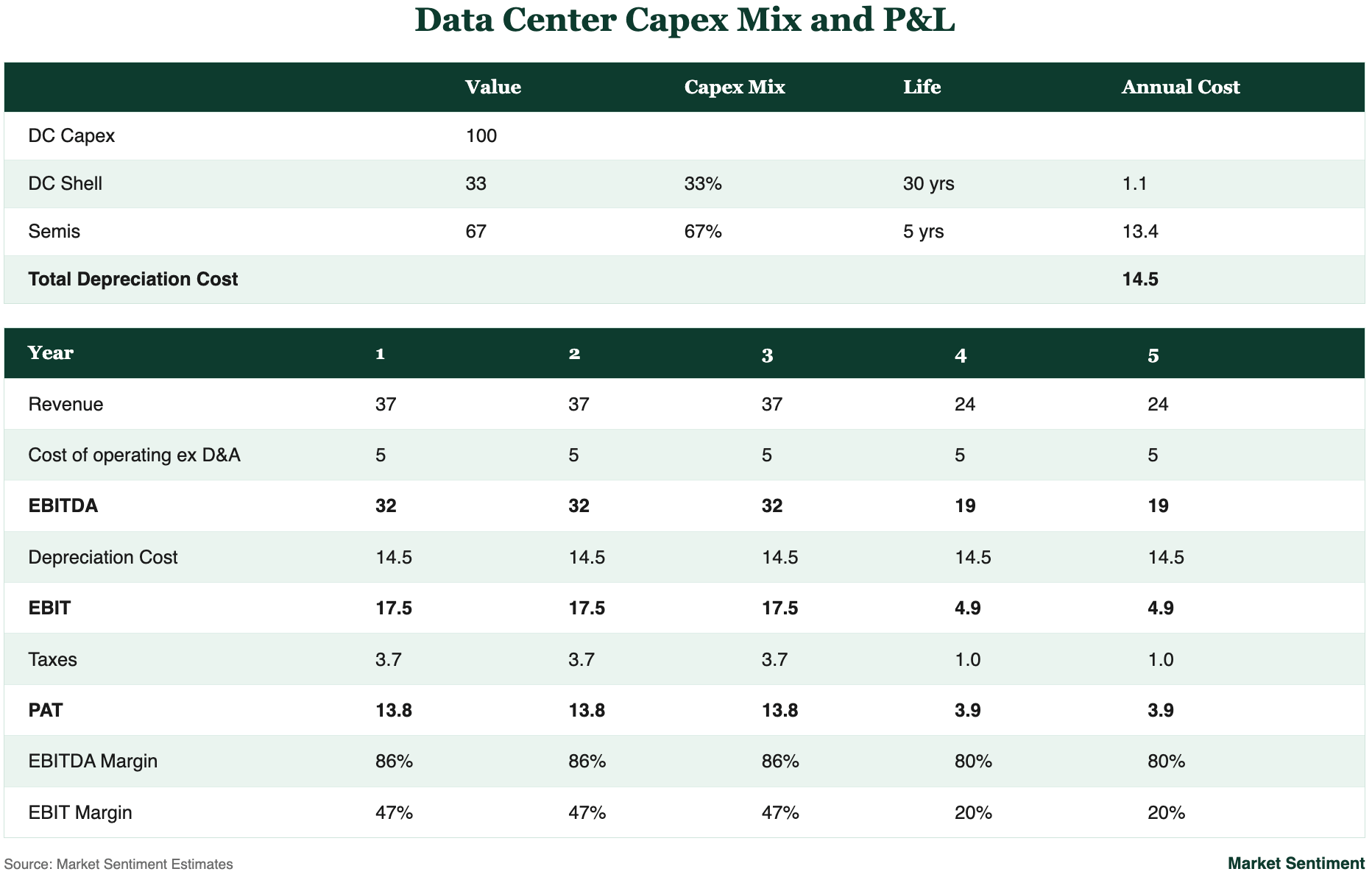
Bringing it all together, we can now model the cash generation of a $100B datacenter.
At a 2:1 semis-to-shell ratio, $67B goes to chips and $33B to the shell.
At 90% rental occupancy, the datacenter will generate $37B in annual revenue for the first 3 years and then $24B for years four and five (assuming a 1/3rd decrease in GPU rental pricing).
Operating costs hold at ~5B per year across 5 years.
Now assume $100B is invested in datacenters every year, and let’s see what steady-state revenue it will generate.
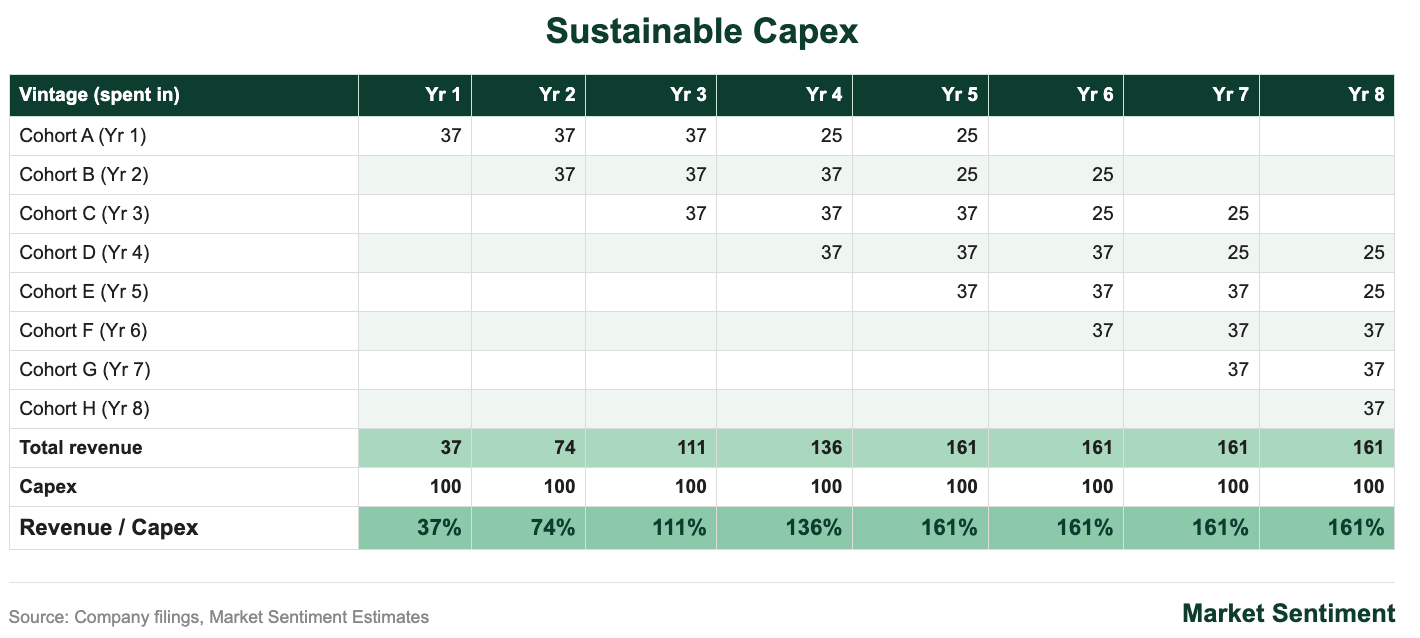
Every $100B of capex buys chips with a five-year life. For the first three years, that cohort generates $37B of revenue annually. In years four and five, revenue drops to $25B as pricing falls with chip age — the decay we saw earlier.
Now spend $100B every year and run it forward. By year five you’re operating five vintages at once: three young cohorts earning $37B each and two aging cohorts earning $25B each.
(3 × $37B) + (2 × $25B) = $161B
That’s steady state. From year five onward, one cohort retires as a new one comes online, so revenue holds at ~$160B while capex stays at $100B.
So a $100B annual capex will generate ~$160B of annual revenue over the long run — a revenue-to-capex multiple of ~1.6x.
Based on our model at this 1.6x multiple and $5B annual costs, a cloud company generates an IRR of ~21%.
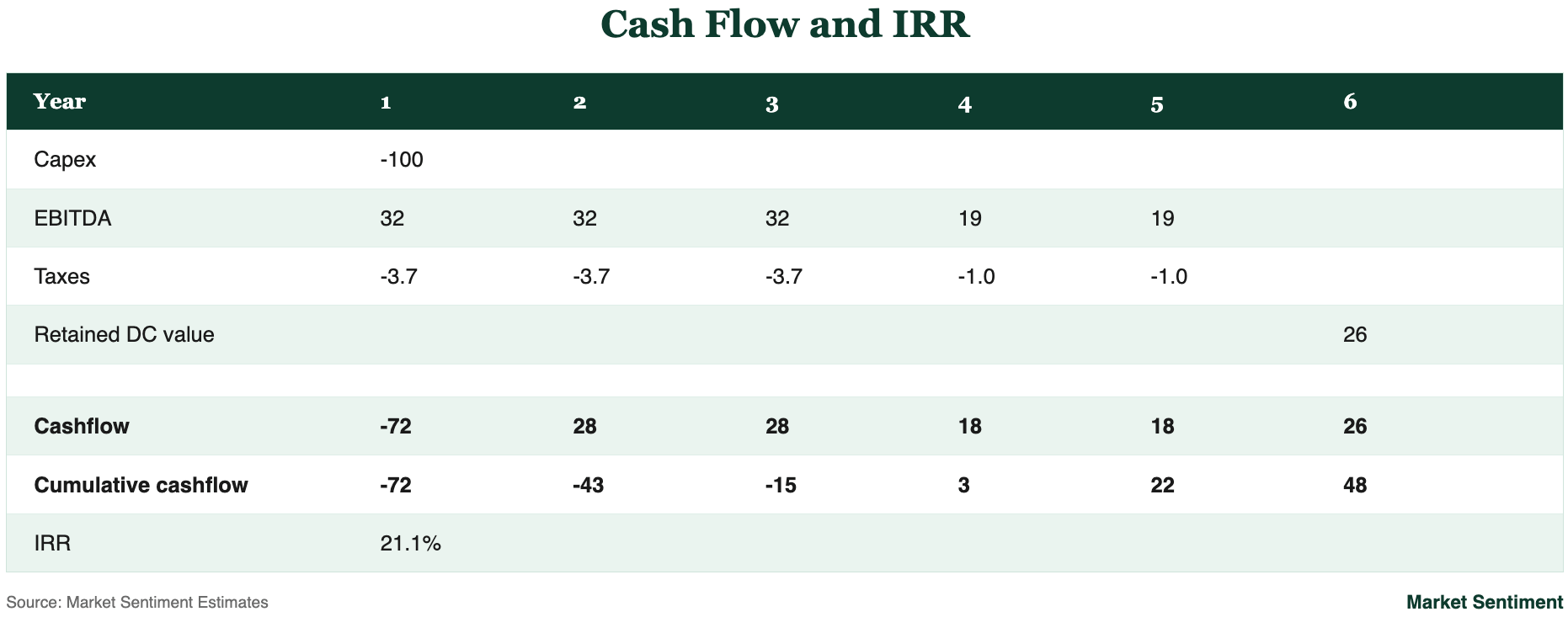
It is worth remembering our conservatism here. We modeled a 5-year semiconductor life, while CoreWeave currently runs up to 6+ years; hyperscalers also have better negotiating power and run a mix of GPUs and more efficient ASICs, both of which support lower operating costs. Adjusting for these, the IRR should land even higher.
Benchmarking against real data
The model implies chip spend is recovered in roughly three years. Now let’s check that against what an H100 purchased in 2023 would actually have earned, based on its purchase price and realized rental rates. An H100 cost an estimated $25–40k in 2023.
Based on SemiAnalysis’s rental price tracker, the average H100 rental rate over its first three years (2023-26) was ~$2.25/hr, peaking at ~$3.00/hr in the early period. Assuming 80% utilization and a 75% cash margin, that generates ~$11.8k of annual cash flow, implying a payback of ~2.7 years. With cloud companies already locking in capacity for 2027-28, realized utilization may run above our 80% base case.
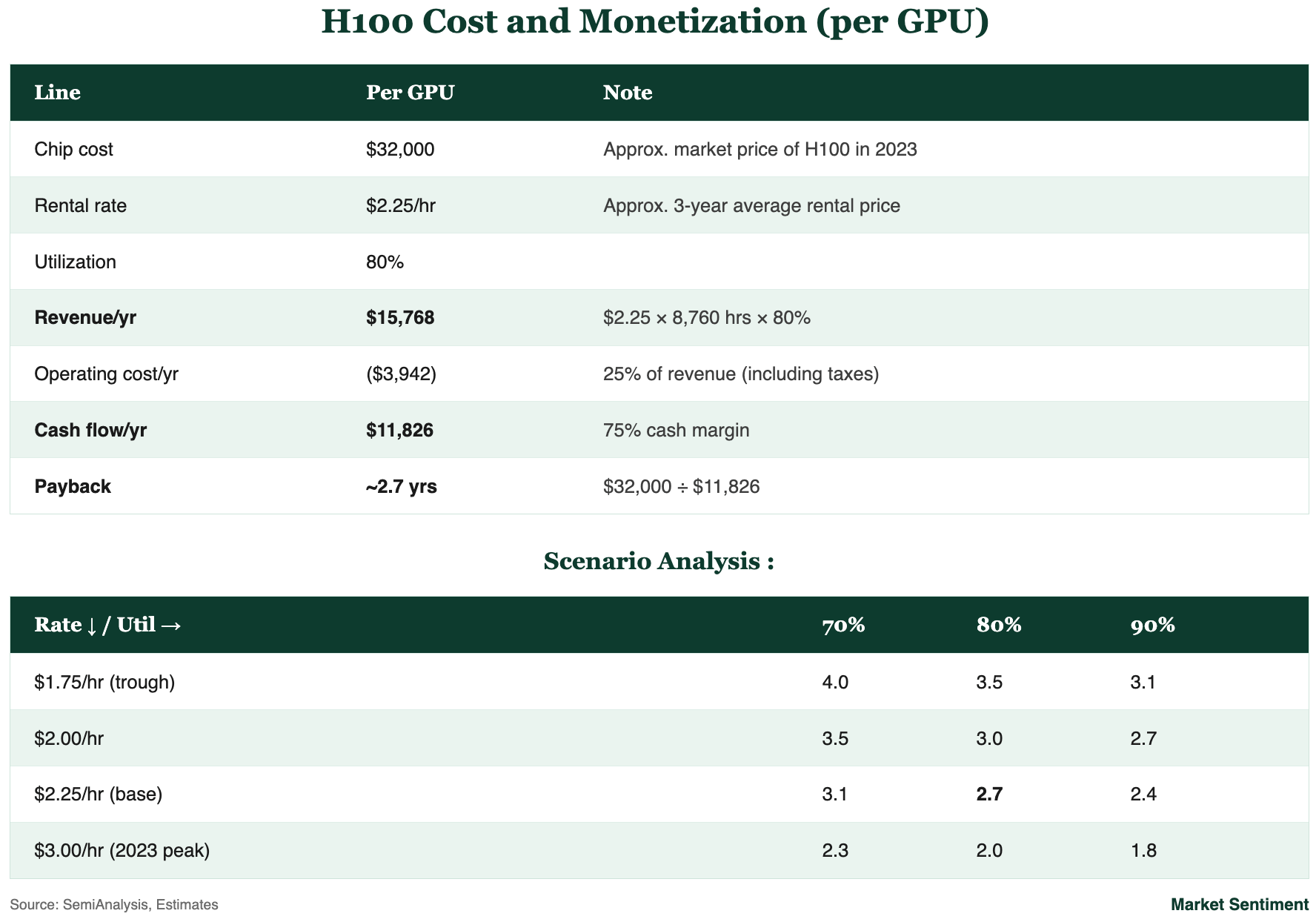
H100 ROI Model | Source: Market Sentiment Research
Morgan Stanley’s unit economics model for a 1GW datacenter built on Nvidia’s latest GB300 chips assumes a materially shorter payback in the current pricing environment. The model implies $23B of semis capex, generating annual cash profit of ~$15B at the low end, leading to a payback of ~1.5 years on the chip spend.
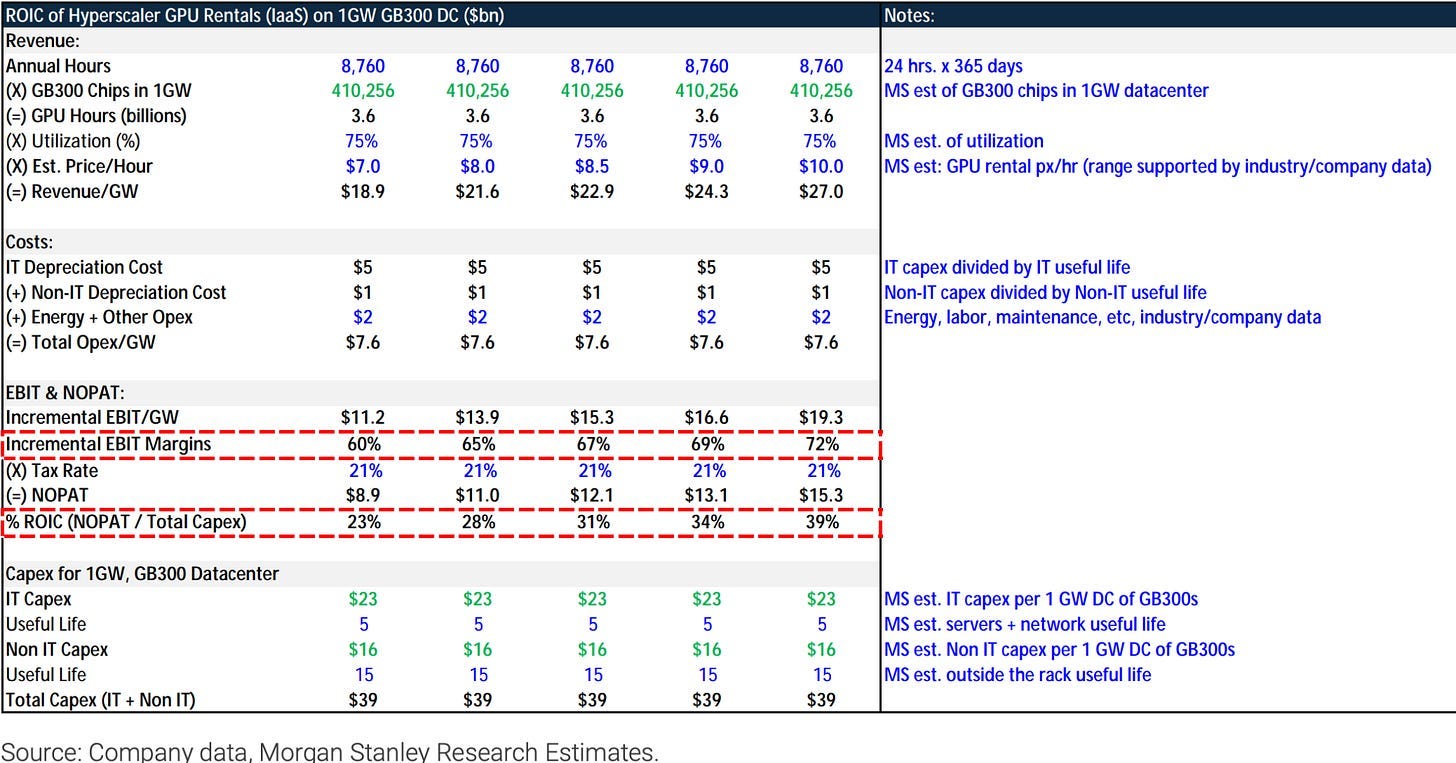
For reference, if we take Morgan Stanley’s pricing (payback period of 1.5 years) for the first 2 years and a 1/3rd price decline every year after that and plug it into our model, we will have an IRR of ~30%. This is how attractive current compute pricing is.
Can revenue get there?
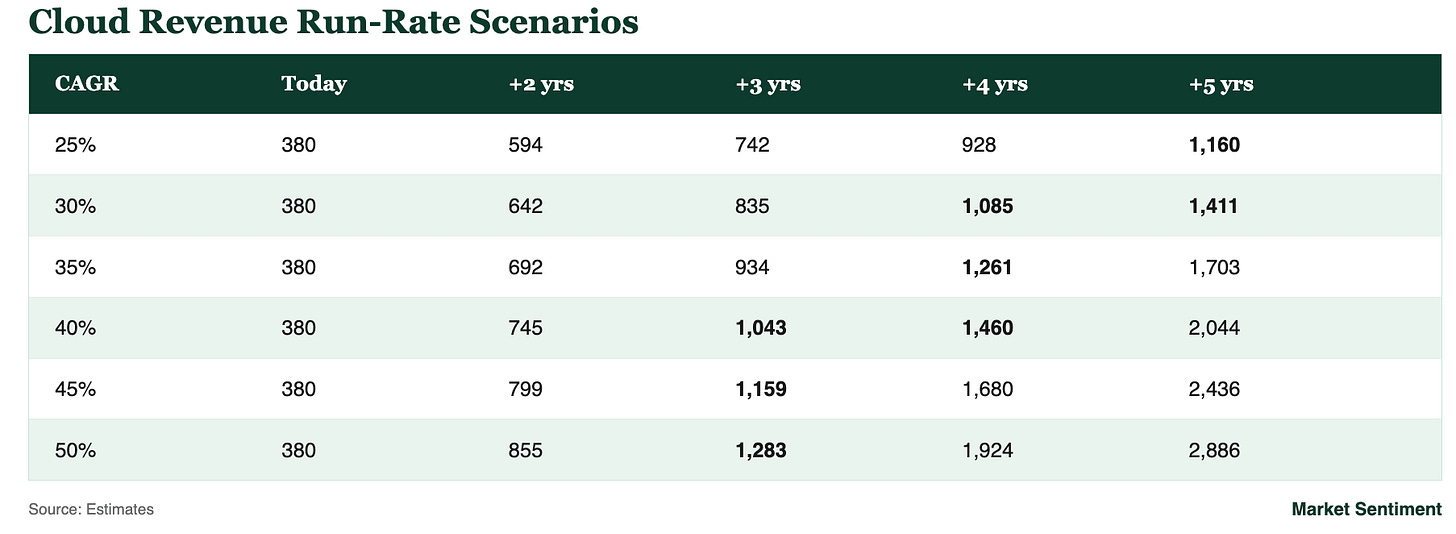
The top three cloud companies are expected to spend ~$600B on capex in 2026, against ~$300B in 2025. Applying the 1.6x revenue-to-capex multiple to that base, they need to generate ~$960B in cloud revenue to sustain the current level of spend.
Today’s combined run rate is ~$380B, growing at 40%+ and still accelerating.
So rather than debating whether the current semiconductor drawdown is a correction or the start of a bubble bursting, the question can be reduced to something simpler: can cloud companies grow their revenue to $960B?
We think they have a reasonable chance. Every major cloud is accelerating on an already large base:
AWS is at a ~$169B run rate, with growth accelerating to 37% from 17.5% a year ago.
Google Cloud has crossed a ~$99B run rate, with growth jumping to 82% from ~32%.
Azure is past $100B and still accelerating, to 43% from ~39%.
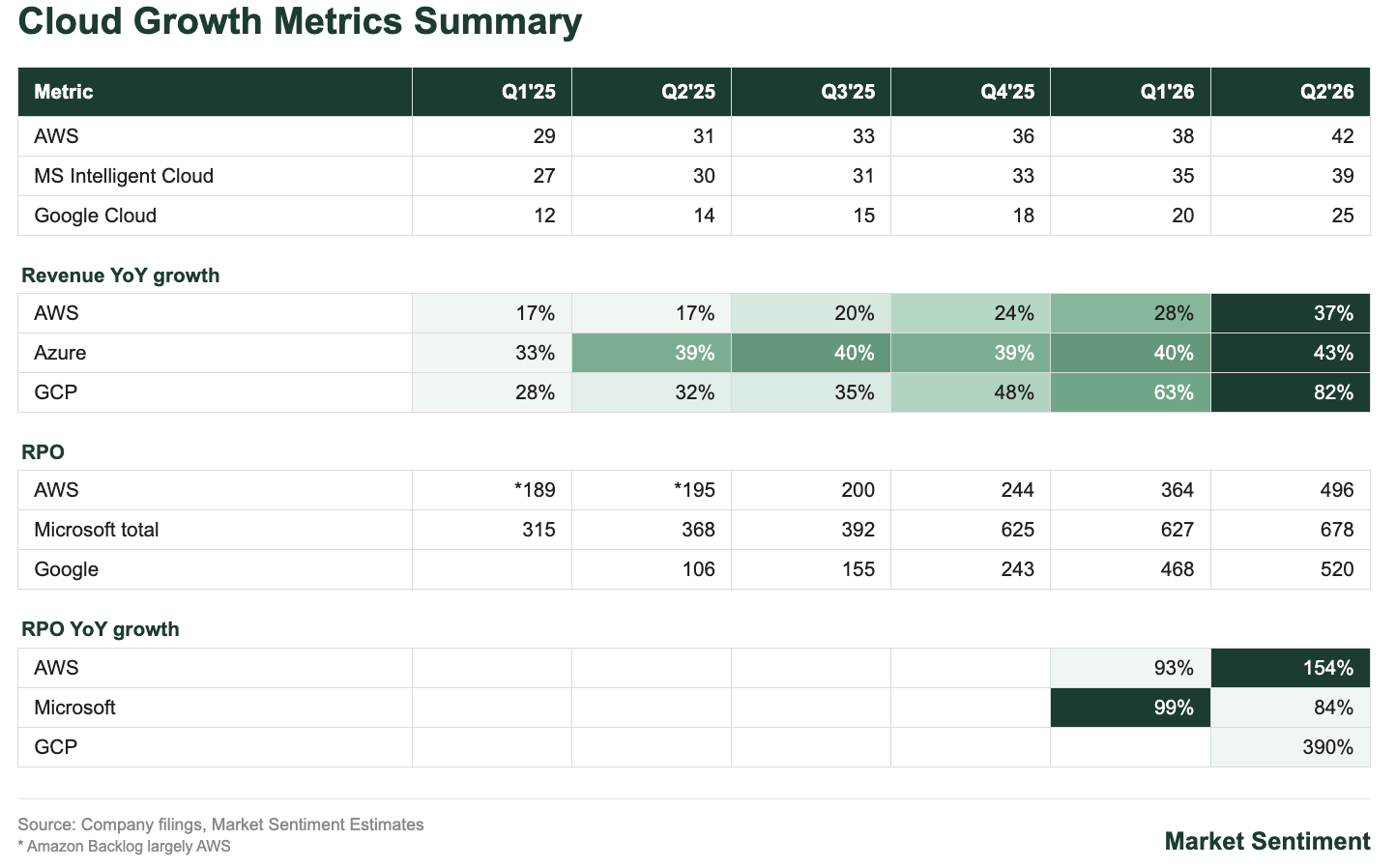
At the current ~40% growth rate, cloud revenue reaches a ~$1T run rate in three years and ~$1.5T in four. Amazon CEO Andrew Jassy has said he expects AWS alone will likely scale to a $1T revenue business over time.
Further, when thinking about their capex, it helps to remember internal capex needs for R&D and first-party products like Search, YouTube, Office and Prime, which would require spending regardless of AI for cloud services. Cloud companies spent ~$100B of capex in 2022, before AI began scaling for consumers.
All in, we think the 2026 capex of ~$600B is sustainable as revenue scales. We will revisit this next year to test whether the Street’s ~$1T estimate for 2027 holds up against actual revenue and bookings growth.
Where it can break
While current growth rates and bookings are great, we see three major risks to cloud demand.
1. The compute demand does not show up
Everything above assumes enterprises and consumers keep using more AI. Usage is growing today, and enterprise spend is rising with it.
Now that the token-maxing era has passed, companies like Coinbase and Uber are optimizing AI budgets by placing monthly spend limits per employee.
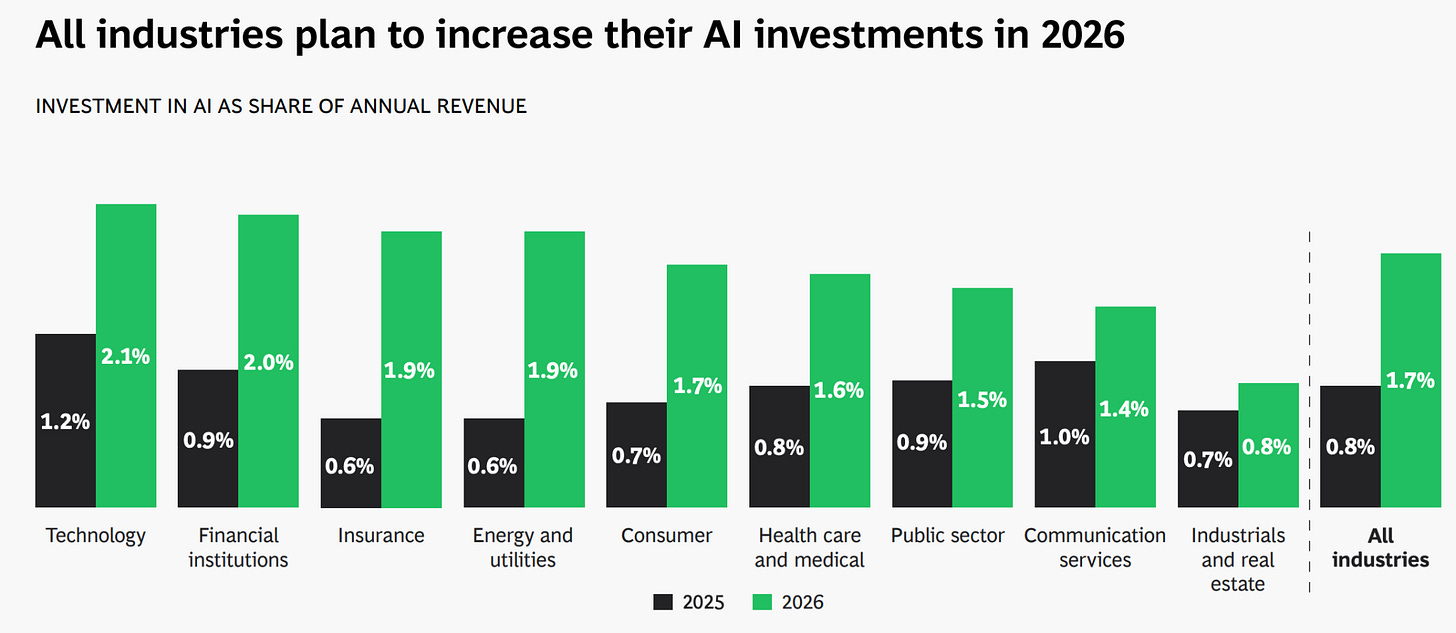
But while some firms trim employee AI credits, aggregate spend keeps climbing as AI penetrates internal workflows. In BCG’s survey of 2,600 C-suite executives, only 6% plan to cut AI spend, while average budgets are expected to double in 2026 versus 2025
2. One big player blows up, and there goes the backlog
Over 40% of cloud backlog traces to two model labs: an estimated ~$700B to OpenAI and ~$330B to Anthropic.
Anthropic last reported a ~$47B run rate as of May 2026, up from ~$9B at the end of 2025, with roughly 80% of revenue from enterprises. Enterprise revenue is stickier and more sustainably monetized, which makes the $330B commitment look better covered.
OpenAI’s run rate is at $25B since February 2026 compared to 2025 revenue of $13.1B and a $20.9B operating loss. It filed a confidential S-1 in June 2026 but has since leaned toward delaying the listing to 2027. We view the OpenAI backlog as carrying more risk.
The right question, though, is what actually happens if OpenAI disappears tomorrow. As a ChatGPT user, I won’t stop using AI. I will switch products, and that platform’s compute demand will absorb OpenAI’s.
3. Decline in demand from VC-funded AI companies
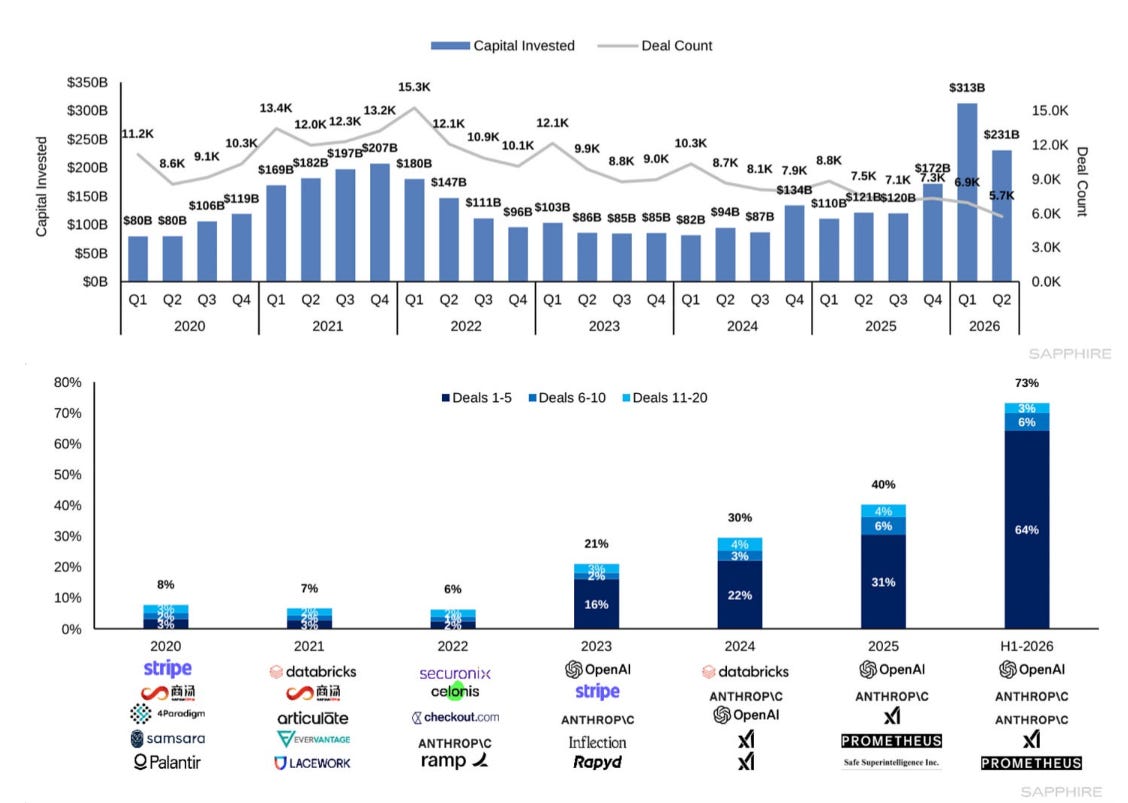
The third risk is a pullback in demand from VC-backed AI startups. Venture funding rose to ~$650B in 1H26 from ~$350B in 2023. Look deeper, though, and a large share concentrates in the top five companies, essentially the AI labs. Exclude those and 1H26 funding is ~$220B, against ~$300B for all of 2023, a difficult year for venture capital.
We therefore don’t see venture investment as a primary driver of AI compute demand. A decline in venture funding would matter at the margin, but ex-labs venture investment has not scaled meaningfully with AI in the first place.
None of this makes it a sure thing. Every bank in the street underwrote the fiber buildout in the dot-com bubble. It worked till it didn’t.
But with this, we have a sneak peek into the math that the hyperscalers and the banks that are underwriting the multi-billion-dollar bonds are looking at. While we are working with public data, they would have access to at least 100x more data points flowing directly from the datacenters.
This is also exactly why we are comfortable positioning MS portfolio across these three categories and have conviction to hold through the market drawdowns.
ASICs (~20% of portfolio)
ASICs enable hyperscalers to improve profitability on the current revenue base and unlock new use cases by pushing down token cost.
Memory (~33% of portfolio)
Memory has seen a sharp correction because of unwinding leveraged trades. With sustained capex of $600B and a large part of it going to inference rather than training, we see memory as a capacity-constrained market for the next one to two years and remain bullish in the near term.
Advanced Packaging (~25% of portfolio)
This category contains manufacturing lines (TSMC, Intel, Amkor) whose revenue is directly linked to chip demand; hence, we remain bullish on them. Capital equipment firms (LRCX, AMAT, KLAC) depend on growth in capex, not sustainability of capex. Sustained capex means no need for new manufacturing lines, which will directly hit their revenue growth. We are least bullish on these firms and will trim our positions as capex guidance peaks at $1T in 2027.
If you made it till here, I would love to hear what you think:
That’s it for now. As you can see, hundreds of hours of research go into each of these reports. Please consider upgrading your subscription to support our work and to get access to all the reports.
Great breakdown of the macro numbers, but the model misses a critical physical and accounting reality: the operational lag between capex deployment and placed-in-service status. Having worked on server room fit-outs, capital allocation does not equal an operational room overnight. Racking, cabling, testing, and grid interconnection bottlenecks add major delays before compute generates revenue. Under GAAP, depreciation does not start until the asset is placed in service. If fit-out or utility delays hold up a cluster for 12 months, you place hardware into service that is already a generation behind, burning part of its 5-year useful life (should be 3 years or less but that is an argument for another day) before making a dollar. That idle capital materially drags down the real IRR.
Really interesting way to move the AI-bubble conversation from headlines to unit economics. It seems like the whole thesis ultimately rests on three things:
- Compute staying highly utilized
- Rental prices declining gradually
- Cloud revenue catching up with capex
If any one breaks badly, the returns change quickly. But at least this gives us the right variables to watch.