


September was all about macro. Oil touched $100 again, the Fed raised rates for the first time since 2023, and the yen carry trade once again raised concerns about a broader market sell-off.
Despite the headlines, the Nasdaq gained 3%, driven by semis, with the SOXX index up 18% as it recovered from the July drawdown. Meta’s Muse launch helped the semis rally by renewing expectations for AI-driven semiconductor demand.
But beneath all the noise, one thing started to change decisively: interest rates. After a long time, bond yields started to take center stage for all investors, as yields kept rising to new highs, with the current 10-year yield at ~5.25%.
Higher bond yields generally mean one of two things: increasing risk in the overall economy or high demand for the limited capital available. Either way, this will limit companies’ ability to invest in new projects, and the benchmark returns investors demand will keep climbing as yields rise.
Historically, rising rates marked the end of major investment cycles in railways, the internet boom, and housing. With rates now moving higher again, the question is whether today’s AI investments continue to grow despite rising costs of capital.
What’s pushing yields up
Long-term yields are driven by two main factors: inflation expectations and the term premium, i.e., the additional return investors demand for locking in their money over long horizons.
Inflation expectations are rising, with oil hovering around $100, tariffs feeding into prices, and loose fiscal policy, with the deficit at ~7% of GDP. Inflation has been so sticky that the Fed is now expected to raise rates 2 times this year to fight inflation.
The term premium is set by supply and demand for bonds, and both sides are pressuring yields.
On the demand side, some of the largest U.S. bondholders, like Japan and Norway, are looking to offload their Treasuries to fund other agendas. Japan wants to defend the yen against the USD and needs more money to intervene in the market. Norway wants to fund AI capex.
On the supply side, hyperscalers are increasingly competing with U.S. Treasury bonds for the same pool of capital. It can because the S&P rates Microsoft bonds at AAA, which is one notch above the federal govt. itself. AI capex is expected to pull in ~$300B of debt in 2026 and a further ~$400B+ in 2027, with total AI capex reaching ~$1.2T in 2027. This would make hyperscaler debt issuance equivalent to ~40%+ of fresh Treasury bond issuance.
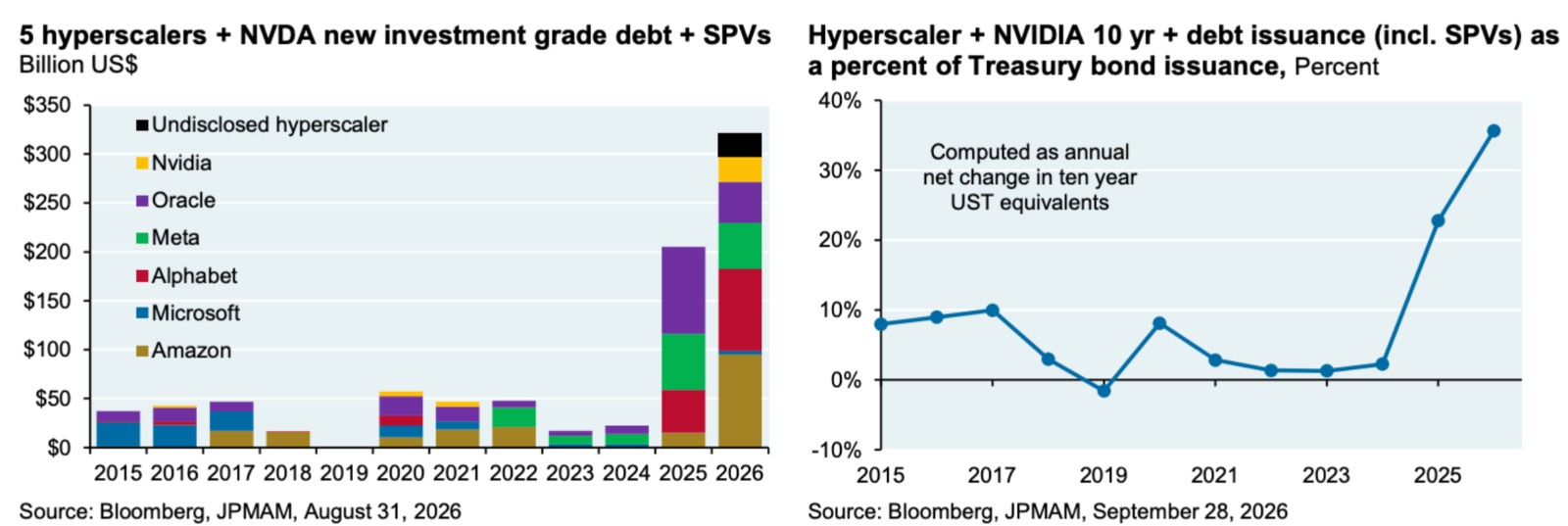
AI debt remains small in aggregate, but on a new-issuance basis, the additional supply is significant. As hyperscalers increasingly rely on debt to fund AI infrastructure, they are competing with Treasuries for the same pool of capital, putting pressure on yields.
How we are positioning:
There is no way out of high yields without less borrowing for AI capex or by the U.S. government, along with lower inflation expectations. But a slowdown in AI capex or government spending would hurt the market.
With AI capex estimates now at $1.2T, our analysis of sustainable capex suggests this should generate ~$2T in revenue for infrastructure companies. As interest rates climb and infrastructure firms slowly ramp revenue, we think we are entering a phase where further AI capex growth beyond 2027 will be limited, if it continues to grow at all.
That said, we are not forecasting an end to the AI capex boom. We see AI as a transformative technology and expect continued investment, but the pace will moderate. The pace of AI capex going forward will be determined by how quickly new applications emerge that use AI. For instance, Muse is one such example.
Therefore, we see this as a good time to slowly shift our portfolio from companies largely driven by demand generated by AI debt (i.e., semis) to other AI enablers that drive the diffusion of the technology into the economy.

To summarize, despite a good September, markets have a tightrope to walk from here, with multiple macro headwinds and little room for further upgrades to the AI capex outlook. Given this evolving situation, we are doubling down on the broadening of AI trade we highlighted earlier and focusing on AI enablers.
Portfolio Update & Position Changes:
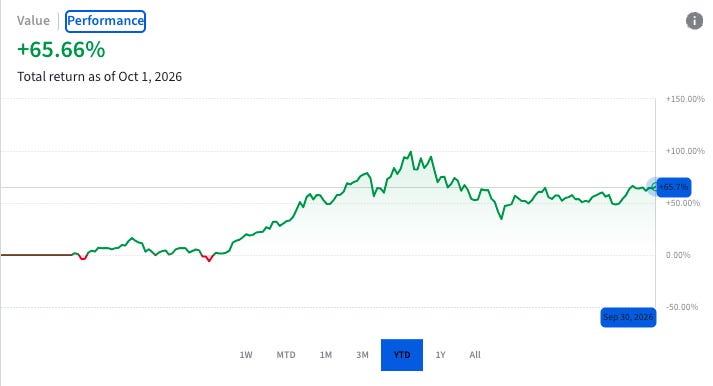
As part of our portfolio transition from AI Capex-driven companies to companies enabling AI adoption, we are making the following changes: